CMJ vs squat jump: what is the difference between these two jumps, and why test both? The countermovement jump (CMJ) starts standing, with a quick dip just before the push. The squat jump (SJ) starts from a bent position, held still. On paper, the distinction is slim. In practice, almost everyone jumps higher in the CMJ, and the gap between the two jumps is one of the most used, and most debated, numbers in strength and conditioning. For a long time, a large gap was read as a sign of good muscle elasticity. Recent studies strongly qualify that reading. In this article, you will see what each jump measures, why you jump higher with a countermovement, how to calculate the SJ/CMJ ratio, how to interpret the gap without misreading it and which protocol to follow to get comparable numbers.
In short: the CMJ measures explosiveness with a countermovement, the squat jump measures the push without momentum. The CMJ is almost always higher: in 45 volleyball players, 42 cm vs 39 cm on average, a CMJ/SJ ratio of 1.11. A large gap is not necessarily a good sign: it can reflect a weak squat jump. Always read the ratio together with both heights.
CMJ and squat jump: two jumps, two starts
Both jumps are done with hands on hips, to isolate the work of the legs. Only the start changes:
| Criterion | Countermovement jump (CMJ) | Squat jump (SJ) |
|---|---|---|
| Starting position | Standing, legs straight | Half squat, knees bent (often around 90°) |
| Before the push | Quick dip, linked without a pause | Position held about 3 s, with no downward movement at all |
| Movement duration | 500 to 1,000 ms[1] | 300 to 430 ms[1] |
| What it tells you | Overall explosiveness, with countermovement | Ability to produce force in a push, without momentum |
Both tests are highly reproducible when the protocol is followed[2]. They are both part of the Bosco test battery, along with the drop jump and repeated jumps. For CMJ reference values, see our article on average vertical jump by age and by sport.
Why do you jump higher in a countermovement jump?
The classic explanation is muscle elasticity: during the descent, tendons and muscles supposedly store energy that is released in the push. A 2017 review re-examined the proposed mechanisms and reached a different conclusion[1]:
- Main explanation: the countermovement takes up the slack in the muscle-tendon unit and leaves more time for muscle activation to build before the push.
- Probably small contribution: storage and release of elastic energy.
- No or small contribution: the stretch reflex and residual force enhancement after stretch.
The practical consequence: the gap between CMJ and SJ does not directly measure elasticity. It mostly reflects what the athlete loses when starting without momentum, that is, their ability to build tension quickly from a still position.
SJ/CMJ ratio: how do you calculate it?
Two formulas are used. They give exactly the same information, in two forms[1]:
- the ratio CMJ ÷ SJ, often called the eccentric utilization ratio (EUR);
- the percentage (CMJ − SJ) ÷ SJ × 100, sometimes called the elasticity index.
| Squat jump | CMJ | CMJ/SJ ratio | Gap |
|---|---|---|---|
| 30 cm | 33 cm | 1.10 | +10% |
| 39 cm | 42 cm | 1.08 | +8% |
| 28 cm | 35 cm | 1.25 | +25% |
| 40 cm | 41 cm | 1.03 | +3% |
The review recommends calculating the gap from height rather than power, and from the average of several jumps rather than the best trial[1]. Height is derived from flight time: see our article on calculating vertical jump height.
How do you interpret the gap between CMJ and squat jump?
Two recent studies change how this ratio should be read. Across 770 participants from different sports, the groups that jumped highest did not have the largest gap: it was highest in physical education students and lowest in speed skaters. The authors conclude that a large gap can reflect good use of the stretch-shortening cycle, but also a weak ability to develop force quickly from a still position[3].
In 45 volleyball players, the mean ratio was 1.11. It was only weakly associated with sprint, change-of-direction and approach jump performance, while CMJ height was the only significant predictor in all models[4].
| Profile | Possible reading | Training focus |
|---|---|---|
| High SJ and CMJ, small gap | Good starting strength, little loss without momentum | Maintain, work on reactive strength (RSI) |
| Low SJ, large gap | Difficulty producing force quickly from a still position | Strength and explosive static starts |
| Low SJ and CMJ, small gap | Overall strength level to develop | Strength base, then plyometrics |
| Ratio changes, heights stable | Often a protocol problem | Check SJ execution |
Remember the rule: CMJ height remains the main indicator, the ratio a complement. To assess reactive strength, which shows up in neither jump, the drop jump and its reactive strength index are better suited.
Standardized protocol to compare CMJ and squat jump
- Hands on hips for both jumps: arm swing changes the result[1].
- No added load: a load acts somewhat like a countermovement and reduces the gap[1].
- Still squat jump: same knee angle at every test, position held about 3 s, no downward movement before the push.
- Three trials per jump, 30 to 60 s of rest, and calculations based on the average.
- Same order, same warm-up, same surface, same device at every session.
- Land with straight legs so as not to artificially lengthen flight time.
One point to watch: a small countermovement in the squat jump can add up to 6 cm in elite athletes, and flight-time field tools do not detect it[1]. The result would then show a falsely small gap. Stand to the side and reject any trial where the hips drop before the push.

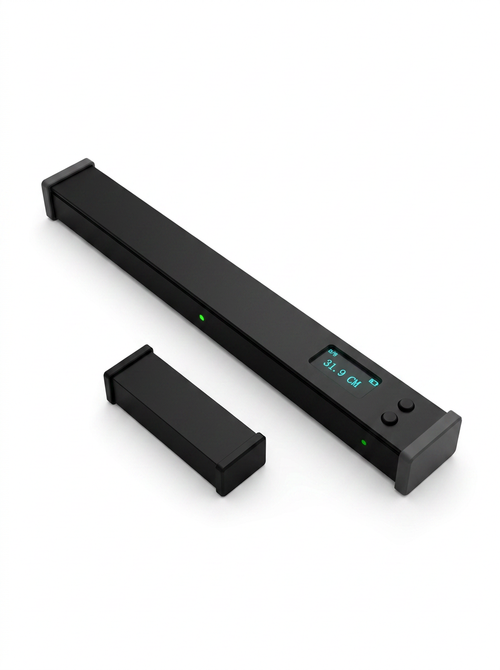
The Jump Gate offers CMJ and squat jump modes, measures flight time at 1,000 Hz and saves each trial per athlete in the free app, so you can track both heights and their ratio over time.
Also in our vertical jump series
Conclusion
The CMJ and the squat jump differ in how they start, and that gap says less about muscle elasticity than was long believed. The countermovement mainly helps put the muscle under tension and build activation before the push. Calculate the ratio from the average height of three jumps, always read it with both heights, and keep CMJ height as the main indicator. The protocol determines the quality of the number: hands on hips, strictly still squat jump, same device. To build these two tests into complete monitoring, follow our guide to measure and improve your vertical jump.
Frequently asked questions
What is the difference between a CMJ and a squat jump?
The CMJ starts standing, with a quick dip linked without a pause before the push. The squat jump starts with knees bent, position held about 3 seconds, with no downward movement at all. Both are done with hands on hips. The CMJ is almost always higher.
What is a good CMJ/SJ ratio?
There is no ideal value. In volleyball players, the mean ratio was 1.11. A high ratio can reflect a weak squat jump rather than good elasticity. Track how it changes in the same athlete, reading it alongside both heights.
Why is my squat jump higher than my CMJ?
It is rare and often an execution problem: a small countermovement in the squat jump, or a CMJ that is too slow or too deep. Film yourself from the side, keep the same knee angle and redo three clean trials of each jump.
Should you test the CMJ with or without arm swing?
To compare it with the squat jump, always without arm swing, hands on hips. The CMJ with arm swing is a separate test, useful for jumping sports, but its numbers cannot be compared with either the standard CMJ or the squat jump.
Sources (accessed October 20, 2026)
- Van Hooren and Zolotarjova (2017), Journal of Strength and Conditioning Research
- Markovic et al. (2004), Journal of Strength and Conditioning Research
- Kozinc et al. (2021), European Journal of Sport Science, 770 participants
- Kozinc, Pleša and Šarabon (2021), International Journal of Environmental Research and Public Health