Quick answer: the vertical jump calculation formula based on flight time is h = g × t² ÷ 8, or about h (m) = 1.226 × t², where t is the flight time in seconds. A flight time of 0.500 s corresponds to 30.7 cm. For a reliable result, you need to measure t to the millisecond and land with straight legs.
There are several ways to measure a vertical jump: touching a mark on the wall, using a vane-type jump tester, filming the jump, or measuring ground forces with a force plate. In the field, the most common method for vertical jump calculation is flight time: you measure how long the feet are off the ground and derive the height from it. It’s the method used by contact mats, optical bars and most video apps.
What is the vertical jump calculation formula?
A jump is a ballistic movement: once the feet leave the ground, only gravity acts. The body takes as long to go up as to come down. Each half of the flight therefore lasts t ÷ 2, and the height reached is:
h = ½ × g × (t ÷ 2)² = g × t² ÷ 8
With g = 9.81 m/s², you get h = 1.226 × t² (h in meters, t in seconds). Example: a flight time of 0.560 s gives 1.226 × 0.560² = 0.384 m, or 38.4 cm.
Conversion table: flight time → vertical jump
| Flight time | Calculated vertical jump |
|---|---|
| 0.300 s | 11.0 cm |
| 0.350 s | 15.0 cm |
| 0.400 s | 19.6 cm |
| 0.450 s | 24.8 cm |
| 0.500 s | 30.7 cm |
| 0.550 s | 37.1 cm |
| 0.600 s | 44.1 cm |
| 0.650 s | 51.8 cm |
| 0.700 s | 60.1 cm |
| 0.750 s | 69.0 cm |
To put these values in context by age, sex and sport, see our article on the average vertical jump.
Why is timing accuracy so important?
Height depends on the square of flight time: a small timing error becomes an error of centimeters. Around 0.500 s of flight:
| Error in flight time | Error in vertical jump |
|---|---|
| 1 ms (1,000 Hz sensor) | about 0.1 cm |
| 10 ms (100 Hz sensor) | about 1.2 cm |
| 2 × 10 ms (at takeoff and landing) | up to about 2.5 cm |
Yet real progress is often counted in one or two centimeters. A sensor that’s too slow can’t tell genuine progress from measurement noise. That’s why reference systems sample at 1,000 Hz, one measurement per millisecond: that’s the case for the Optojump[1] as well as the Jump Gate.
Which mistakes skew the vertical jump calculation?
1. Bending the legs on landing
The formula assumes you land in the same posture as at takeoff. If the athlete tucks their knees or lands heels first, they stay in the air longer and the vertical jump is overestimated. A simulation published in 2024 puts this overestimation at about 18% for a 30 cm jump, with a flexed-ankle landing[2]. The cue: take off and land with straight legs, toes first.
2. Changing calculation method
Force plates often calculate height from takeoff velocity (impulse method). In 23 professional soccer players, the difference between the two methods averaged 3.2 cm, versus 1 cm when comparing two devices using flight time[3]. So never compare a number obtained from flight time with one obtained from impulse.
3. Using the arms one day and not the next
Arm swing adds several centimeters. For tracking, fix the protocol: hands on hips (standard CMJ) or free arms, but always the same.

How do you measure flight time without a lab?
- A handheld stopwatch: unusable, the operator’s reaction time far exceeds the accuracy needed.
- Slow-motion video: you count the frames between takeoff and landing. Validated apps give good results[4], but every jump has to be filmed and analyzed.
- A contact mat: it detects the presence of the feet. Reliable, but it has to be laid out, connected and carried.
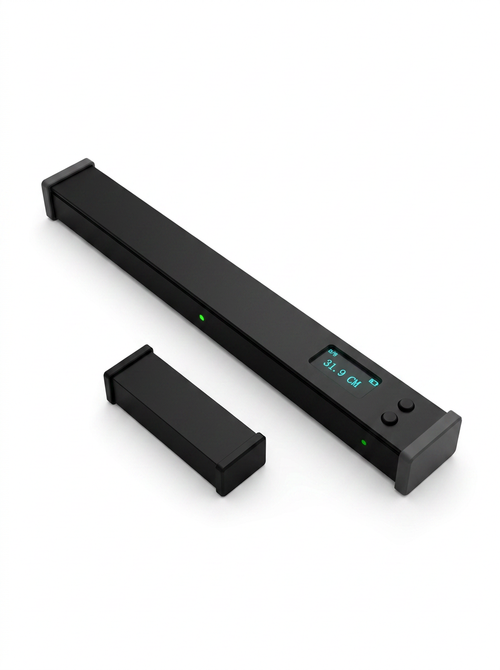
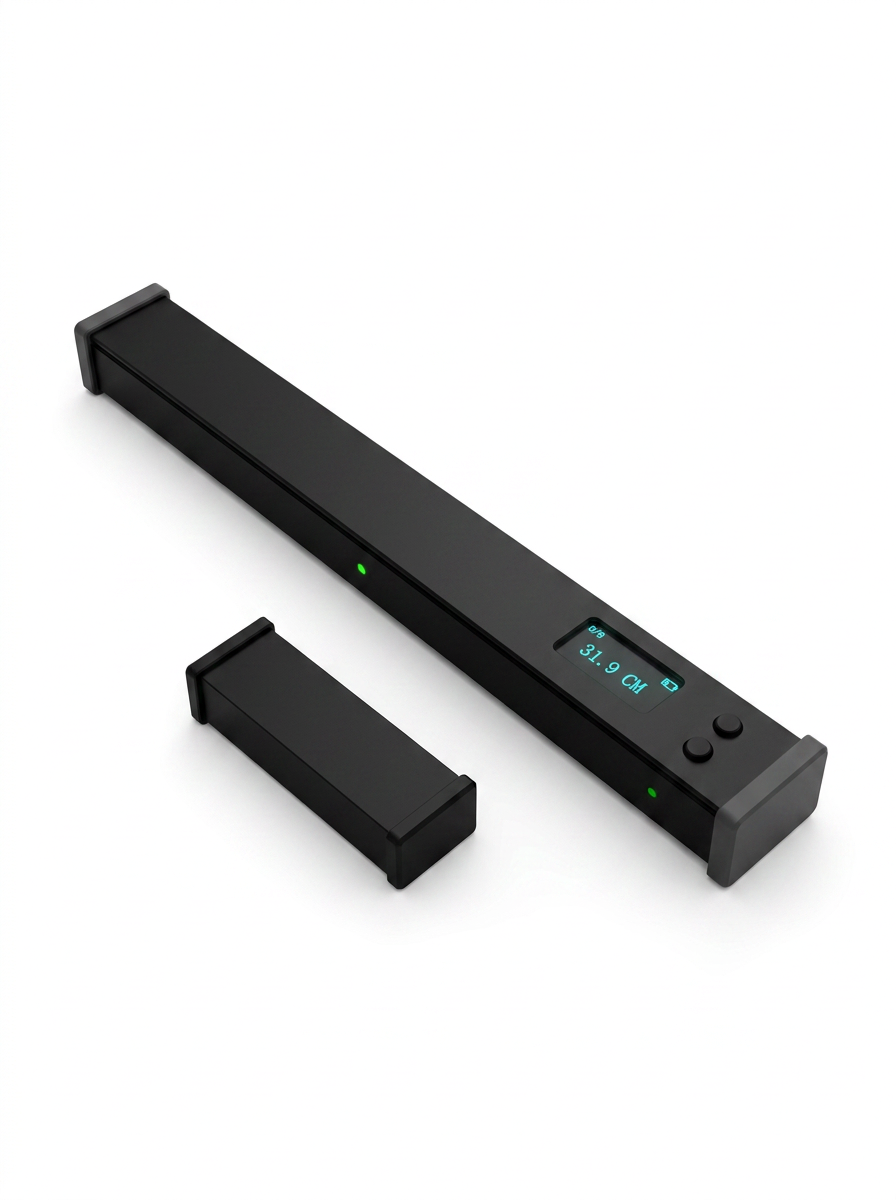
- Optical bars: two bars on the floor create an infrared beam; the sensor detects when the feet break it. That’s the principle of the Optojump and the Jump Gate.
The Jump Gate (€249.99) uses two infrared bars sampled at 1,000 Hz. It displays the height directly on its screen, without calibration or a phone, and also measures ground contact time and the reactive strength index (RSI). For the complete testing and progression method, read our guide how to measure and improve your vertical jump. And to compare devices, our Optojump comparison.
How do you calculate RSI from flight time?
In a drop jump, you also measure ground contact time before the rebound. The reactive strength index is calculated as follows:
RSI = jump height (m) ÷ contact time (s)
Example: 0.30 m of height for 0.200 s of contact gives an RSI of 1.5. RSI measures the ability to jump high and fast: it’s the key indicator for plyometric work. It can be measured very reproducibly from a 30 cm drop height[5]. The Jump Gate calculates RSI automatically on every rebound. To combine it with reaction work on visual stimuli, the Explosiveness Pack brings together the Jump Gate and reaction lights, from €548.99.
Reverse calculation and power estimation
The formula works both ways. To find the flight time needed for a target vertical jump, use t = √(8 × h ÷ g). Example: to jump 40 cm, you need to stay in the air √(8 × 0.40 ÷ 9.81) = 0.571 s. Going from 40 to 42 cm requires only 14 ms of extra flight: that’s the order of magnitude a sensor must be able to distinguish.
From vertical jump and body weight, you can also estimate peak leg power. The Sayers equation, used for adults in the large 2026 Finnish study[7], reads:
Power (W) = 48.3 × vertical jump (cm) + 50.1 × mass (kg) − 1,890
| CMJ height | Mass | Estimated power | Per kilo |
|---|---|---|---|
| 30 cm | 70 kg | about 3,070 W | 44 W/kg |
| 40 cm | 75 kg | about 3,800 W | 51 W/kg |
| 50 cm | 85 kg | about 4,780 W | 56 W/kg |
It’s a statistical estimate, not a measurement: it’s used to compare athletes of different weights, or to track an athlete who gains or loses weight. For those under 18, researchers use a different equation[7].
Frequently asked questions
How do you calculate your vertical jump without equipment?
Measure your standing reach with your arm extended against a wall, then the highest point you touch when jumping: the difference gives your vertical jump. It’s a useful estimate to get started, but less accurate and less reproducible than flight time measured by a sensor.
What is the Bosco formula?
Carmelo Bosco is often credited with popularizing the jump test based on flight time, measured to the thousandth of a second[6]. The calculation used is the ballistic formula h = g × t² ÷ 8.
Does flight time overestimate vertical jump?
Yes, if you land with bent knees or ankles. With a straight-legged landing, the difference between the Optojump and a force plate is about 1 cm[8].
How accurate does a measurement need to be to track progress?
Flight time measured to the millisecond, which means about 0.1 cm of error from timing. Jump-to-jump variability is still on the order of 2.4 to 4.6%: do 3 jumps and track the average.
Sources (accessed October 10, 2026)
- mtraining.fr — Optojump Next technical sheet (1,000 Hz)
- PeerJ (2024), effect of landing posture on calculated height
- Frontiers in Sports and Active Living (2024), flight time vs impulse
- Balsalobre-Fernández et al. (2015), Journal of Sports Sciences
- Flanagan, Ebben & Jensen (2008), Journal of Strength and Conditioning Research
- Bosco et al. (1983), European Journal of Applied Physiology
- Koivunen et al. (2026), Scandinavian Journal of Medicine & Science in Sports
- Glatthorn et al. (2011), Journal of Strength and Conditioning Research