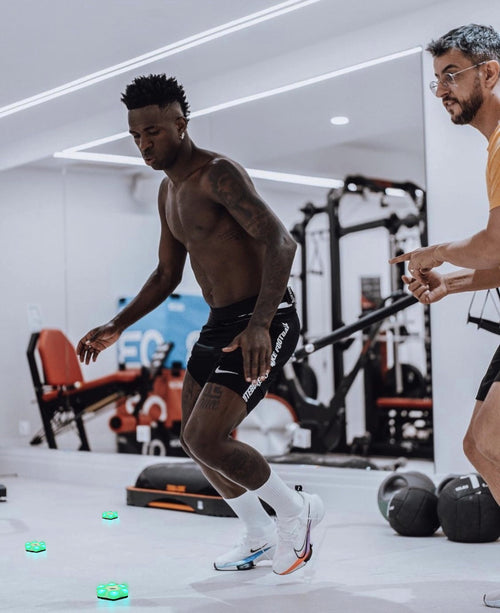
Reaction lights in physical therapy are increasingly common in clinics that treat athletes, and in general rehab too. Their value isn’t the visual effect. They bring two things that classic exercises provide poorly: an unpredictable signal, which forces the patient to perceive and decide before moving, and an objective measurement of the response, in milliseconds. Those are precisely the two elements that are often missing between the end of rehab and the return to the field. This article covers practical uses in a physical therapy clinic: proprioception, return-to-play training, return-to-sport tests, measured tracking and hygiene. It also outlines the limits: the lights are a tool serving the clinician’s protocol, not a medical device, and return-to-play decisions remain those of the physical therapist and the physician.
Quick answer: in a clinic, 4 to 6 reaction lights are enough to add an unpredictable stimulus to proprioception exercises, return-to-play work and end-of-rehab tests. They let you compare the injured side and the healthy side on the same exercise, in reaction time and errors. They belong at the end of the pathway, once the clinical criteria have been validated by the clinician.
Why use reaction lights in physical therapy rehab?
After a knee injury, conventional rehab mostly works on movements known in advance: a squat, a jump, a side shuffle. Yet non-contact injuries often happen when the athlete has to react to the unexpected. A review published in JOSPT proposed a framework on this point: after an anterior cruciate ligament rupture, movement control may rely more on vision, and rehab would benefit from including visuomotor exercises in addition to classic neuromuscular work[1].
Reaction lights meet this need simply. The patient doesn’t know which target will light up: they have to perceive, choose and move. The physical therapist precisely doses the difficulty:
- the distance between the patient and the lights;
- the number of targets and distractor colors;
- the delay between two signals;
- the type of response: slow movement, weight shift, jump, change of direction.
A practical advantage of pods with a motion sensor: the patient doesn’t need to hit the light. A controlled movement nearby is enough, which allows impact-free work early in the progression. For a general overview of reaction lights and how to choose them, see our guide to sports reaction lights.
Proprioception rehab: adding an unpredictable stimulus
In proprioception, the goal is to maintain good postural control while the patient’s attention is drawn elsewhere. The lights let you add this dual task progressively.
| Stage | Patient position | Example with lights |
|---|---|---|
| 1 | Double-leg stance, stable floor | 2 lights on the wall at hand height, slow movement toward the lit color |
| 2 | Single-leg stance, stable floor | 3 lights in an arc, hand response without putting the free foot down |
| 3 | Single-leg, unstable surface | Same lights, add a distractor color to ignore |
| 4 | Lunge or step toward the target | Lights on the floor, foot response, return to starting position |
Moving from one stage to the next is based on clinical criteria: quality of control, no pain, no compensation. The timer is just additional information. If reaction time improves but knee alignment deteriorates, the exercise is too hard.
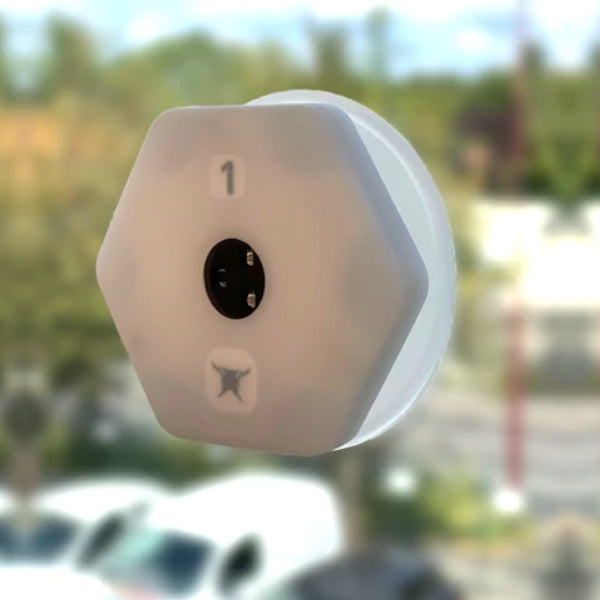
To mount the lights on glass, a mirror or tiles, mounting suction cups (€27.99 for 4) avoid drilling or gluing. The Velcro straps included with the kit also let you install them on wall bars or a post.

Return-to-play training: from controlled movement to reactive agility
In return-to-play training, the patient becomes an athlete again. The lights then serve to gradually reintroduce the demands of the sport: speed, changes of direction, decisions under pressure.
A typical progression, to adapt to the patient and to medical clearance:
- Short straight-line movements: 2 lights 3 m apart, back and forth toward the lit color.
- Lateral shuffles: 3 to 4 lights in a line, the patient stays facing the lights.
- Planned, then reactive changes of direction: same course, but the target is only known at the last moment.
- Reaction with jump landing: the patient jumps, the target lights up during the airborne phase, they land and move toward it.
- Sport-specific exercises: with a ball, a racket or an opponent.
For a soccer player at the end of the pathway, the field drills described in our article on reaction light drills for soccer can serve as the final stage, at controlled intensity.
Return to sport: which reactive tests should you run?
Return to sport after ACL reconstruction is a high-stakes decision. In a cohort of 106 patients playing pivoting sports, each month of delay before returning reduced the knee reinjury rate by 51%, up to 9 months after surgery. 38.2% of patients who failed the return criteria were reinjured, versus 5.6% of those who passed them[2].
These classic criteria (quadriceps strength, hop tests, questionnaires) are predictable. American authors propose adding reactive tests performed with reaction lights: lateral movement toward the targets in 30 seconds, a four-corner test, right-foot response to one color and left-foot response to the other in 15 seconds[3]. They note that the reliability and predictive value of this battery have not yet been evaluated.
In practice, these tests are useful for comparing both sides and tracking progress, not for deciding return to play on their own. They come after the usual clinical and functional criteria have been validated, and the decision remains shared between the patient, the physical therapist, the physician and, if needed, the surgeon.
Measured tracking, hygiene and clinic organization
Comparing the injured side and the healthy side
The app measures average reaction time, best time and errors. Perform the same exercise on the injured side then the healthy side, under the same conditions, and note the difference. Repeat this baseline test every 2 to 4 weeks. Each patient has a profile, with their session history and a PDF or CSV export, useful for a report to the referring physician. To limit the personal data stored, you can name profiles with initials or a number.
Hygiene
The lights are shared between patients: clean them according to the clinic’s hygiene protocol for shared surfaces. The pods aren’t waterproof: use a slightly damp wipe, without immersion or direct spraying. Contactless detection also limits direct contact with the light.
Beyond athletes
In older adults, a meta-analysis showed that step training, voluntary or reactive, reduces the fall rate by about half[4]. Lights on the floor allow this type of exercise, with short distances and appropriate safety.
Also in our reaction and reaction lights series
- BlazePod alternative: the comparison (price, subscription, detection)
- How to improve reaction time: 5 drills with reaction lights
- FitLight vs BlazePod: the comparison, and the alternative for under €320
- Average reaction time: values by age and sport, and how to measure it
- Witty SEM alternative: comparing Microgate reaction lights
Conclusion
In a physical therapy clinic, reaction lights have three uses: enriching proprioception with a dual task, bringing return-to-play work closer to the field, and objectifying progress before return to sport. They replace neither the clinical exam, nor return criteria, nor the physician’s opinion. A kit of 4 to 6 lights is enough for most exercises, and suction cups make wall installation easy. If you’re still comparing systems, read our A-Champs ROXs vs Powereact comparison. To equip your clinic, Powereact reaction lights cost €319.99 for 4 pods, with a free app and no subscription.
Frequently asked questions
Are reaction lights a medical device?
No. Powereact reaction lights are a training and measurement tool. They fit into the protocol defined by the physical therapist or physician, who alone decides which exercises suit the patient and the criteria for progression or return.
What proprioception exercises can you do with reaction lights?
Start in double-leg stance on a stable floor, with a slow movement toward the lit light. Progress to single-leg stance, an unstable surface, adding a distractor color, then lunges and steps toward the target, according to the patient’s clinical criteria.
What tests should you do before returning to sport after an ACL injury?
The classic criteria remain the foundation: quadriceps strength, hop tests, questionnaires and time since surgery. Reactive tests with reaction lights can complement this assessment to compare both sides, but their predictive value is not yet established.
How do you mount reaction lights on a clinic wall?
On a smooth surface such as glass, a mirror or tiles, use mounting suction cups. On wall bars or a post, the Velcro straps and zip ties included with the kit are enough. That way you avoid drilling or gluing.
Sources (accessed October 20, 2026)
- Grooms, Appelbaum & Onate (2015), JOSPT: neuroplasticity after ACL rupture and visuomotor training
- Grindem et al. (2016), British Journal of Sports Medicine: Delaware-Oslo cohort, return criteria after ACL
- Wilk et al. (2023), International Journal of Sports Physical Therapy: reactive return-to-sport tests after ACL
- Okubo, Schoene & Lord (2017), British Journal of Sports Medicine: step training and falls