Reaction lights in soccer serve one specific purpose: forcing the player to read a signal before acting, just like in a game. A cone course trains a movement known in advance. A light that turns on at random adds visual scanning and decision-making. The challenge for the coach or strength and conditioning coach is to go from the idea to concrete sessions, with clear dosage and useful measurement. This article offers 8 soccer reaction drills and cognitive training exercises, from the first step without the ball to the small-sided one-on-one, including the goalkeeper. For each: the setup, the cue and the dosage. You will also find what the research says, a summary table and the rules to track a player's progress without misreading the numbers.
In short: 4 to 6 reaction lights are enough for the 8 drills in this article. Work in short sets of 20 to 30 seconds, with rest at least twice as long, 2 to 3 drills per session, at the start of the session when players are fresh. Measure the average time and the number of errors on a fixed benchmark drill, every 2 to 4 weeks.
Why use reaction lights in soccer?
In a game, a player rarely changes direction on a signal known in advance. They react to an opponent, the ball, a teammate. Researchers therefore distinguish change-of-direction speed (a planned course) from reactive agility, which includes perception and decision-making[1]. A study in team sports showed that these two qualities are largely independent: being fast on a fixed course does not guarantee being fast when you have to read a signal[2].
The cognitive side matters too. In Swedish first- and second-division soccer players, scores on an executive function test correlated with the number of goals and assists over the following seasons (r = 0.54, 25 players)[3]. The study is small and correlational, but it supports the value of decision-making in training.
The effects of training with light stimuli remain variable. In 38 young soccer players followed for 6 months, the group trained with lights improved, with no significant difference from traditional training on most measures[4]. The lesson: lights do not replace playing. They provide an unpredictable signal and precise measurement, to be built into drills that resemble the field. For the basics and choosing equipment, see our guide to reaction lights for sports.
Drills 1 to 3: first step and reactive agility in soccer
1. Star first step
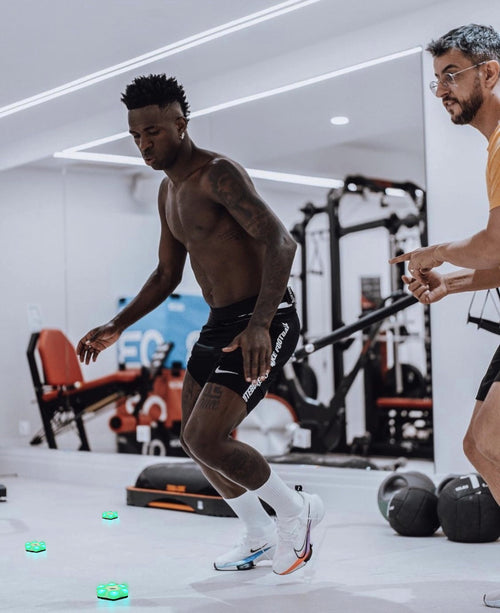
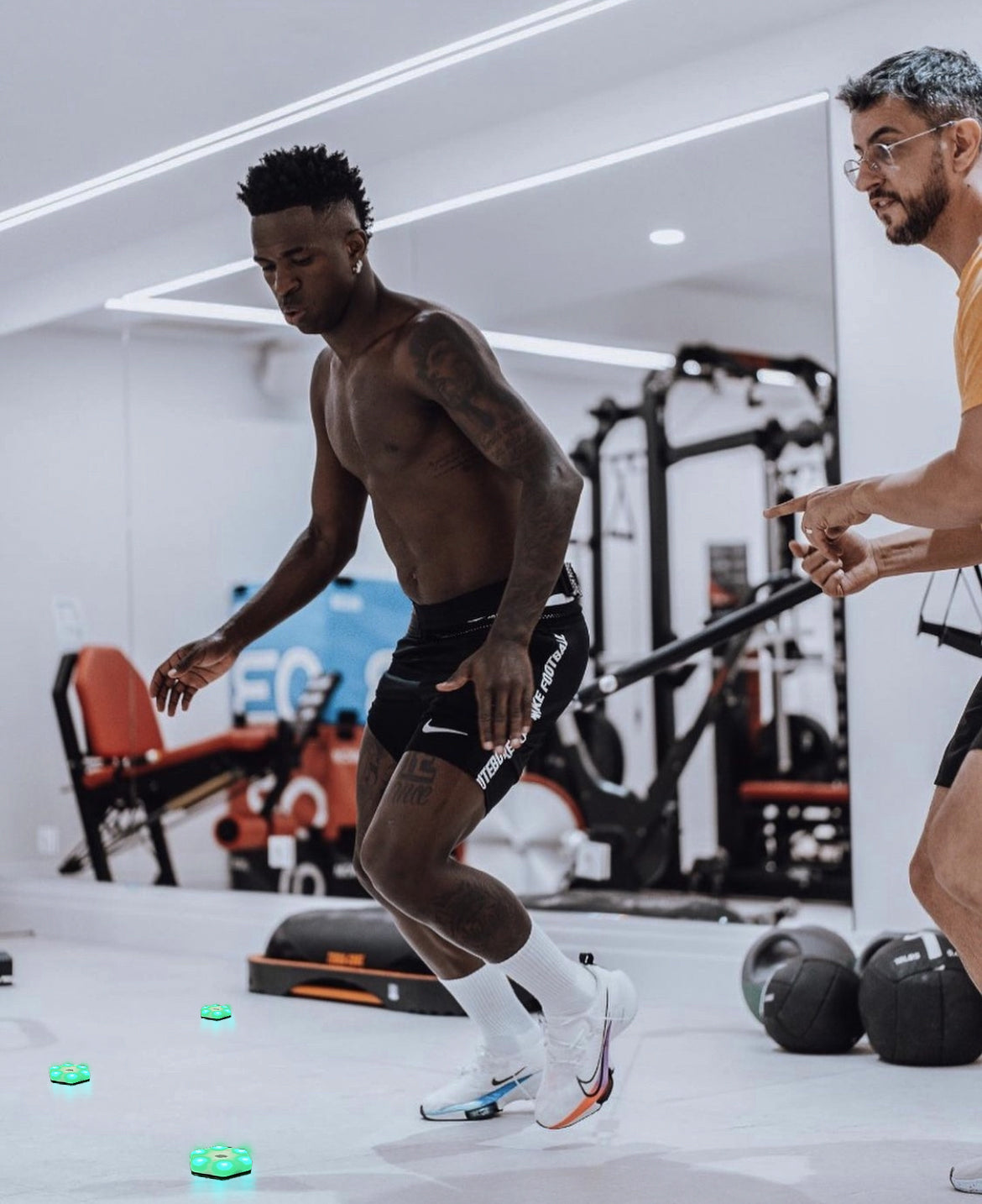
Setup: 4 lights on the ground in a cross, 3 m from a central cone. Cue: the player, in an athletic stance, sprints to the lit light, triggers it with the foot and returns to the center. Dosage: 3 sets of 20 seconds, 60 seconds of rest. Goal: the first step, oriented toward the target.
2. Choice reaction: the right color
Setup: 4 lights in a line 2 m apart, 4 m from the player. Cue: only green is a target; red is a trap to ignore. Dosage: 3 sets of 12 signals. Count the average time and the errors. Goal: inhibition, stopping a false start.
3. Funnel reactive agility
Setup: 2 lights 5 m away diagonally left and right, a third in the center at 8 m. Cue: the player runs forward; a light turns on during the run, and the player changes direction toward it. Dosage: 6 to 8 reps, walk back. Goal: deciding on the move, like facing a defender who closes off one side.
Drills 4 to 6: on the ball and decision-making
4. Directional first touch
Setup: 1 passer, 1 player in the center, 2 lights 5 m to the left and right. Cue: as the ball arrives, a light turns on; the player takes a first touch toward that side and dribbles to the light to trigger it. Dosage: 2 sets of 8 balls. Goal: scanning before the first touch.
5. Pass to the color
Setup: 3 teammates in an arc, a light attached at the feet of each with Velcro or a zip tie. Cue: on the signal, the player in the center passes to the teammate whose light is on. The teammate triggers the light with the ball contact. Dosage: 3 sets of 30 seconds. Goal: decision speed on the pass.
6. Dribbling and change of direction
Setup: 6 lights scattered in a 10 m square. Cue: the player dribbles and turns off each lit light with the foot, without losing the ball. Dosage: 3 sets of 25 seconds, 75 seconds of rest. Goal: keeping the head up while dribbling.

Drills 7 and 8: goalkeeper and one-on-one
7. Goalkeeper: reaction and lateral first step
Setup: 4 lights attached to the posts, at knee and shoulder height, with zip ties. Cue: the goalkeeper, in the ready position, moves toward the lit light and triggers it with the hand. You can add a shot from the coach right after the signal. Dosage: 4 sets of 6 signals, 90 seconds of rest. Goal: reaction and positioning.
8. One-on-one: who turns it off first?
Setup: 2 players face to face, 4 lights on the ground between them, 3 m from each. Cue: each player has a color; the first to turn off a light of their color scores a point. As a variation, a ball in the center: the player whose color lights up attacks, the other defends. Dosage: 5 duels of 15 seconds. Goal: reacting under pressure from an opponent, like a small-sided game.
The app's multiplayer mode handles color assignment and scoring. For a general six-week progression without the ball, see our 5 drills to improve your reaction time.
Soccer agility: dosing and tracking progress
| Drill | Lights | Quality trained | Dosage |
|---|---|---|---|
| 1. Star first step | 4 | Reaction, first step | 3 × 20 s |
| 2. The right color | 4 | Inhibition | 3 × 12 signals |
| 3. Funnel | 3 | Reactive agility | 6 to 8 reps |
| 4. Directional first touch | 2 | Scanning | 2 × 8 balls |
| 5. Pass to the color | 3 | Passing decisions | 3 × 30 s |
| 6. Dribbling | 6 | Head up while dribbling | 3 × 25 s |
| 7. Goalkeeper | 4 | Reaction, positioning | 4 × 6 signals |
| 8. One-on-one | 4 | Reaction under pressure | 5 × 15 s |
Three rules make the measurement useful. Place these drills at the start of the session, after the warm-up: reaction deteriorates with fatigue. Pick a benchmark drill (for example No. 2), always under the same conditions, and repeat it every 2 to 4 weeks. Read the average time together with the number of errors: gaining 20 milliseconds while making twice as many mistakes is not progress. The app saves every session per player and exports to PDF or CSV.
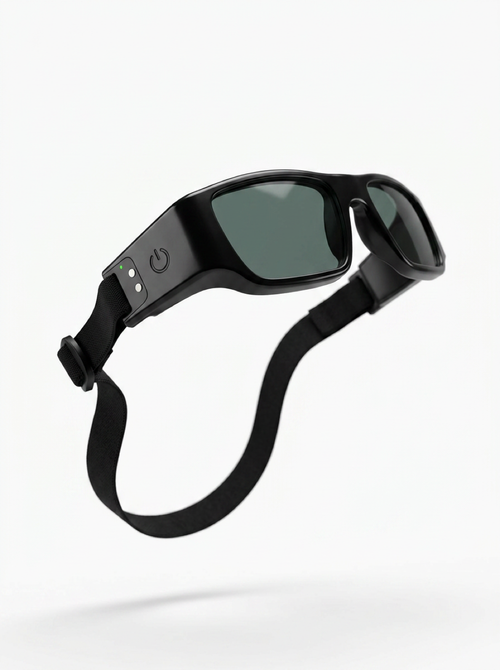
To go further on scanning, the Perception Pack pairs the lights with strobe glasses. The pods are designed for use in dry weather: put them away if it rains.
Also in our reaction and reaction lights series
Conclusion
Eight drills are enough to structure reaction and decision-making work in soccer: first step, choice reaction, reactive agility, directional first touch, passing, dribbling, goalkeeping and one-on-one. With 4 to 6 lights, short sets and a fixed benchmark drill, you get both game-like training and data-driven tracking. If you are still comparing systems, read our comparison A-Champs ROXs or Powereact and our FitLight alternative. To equip your group, a kit of 6 Powereact reaction lights costs €419.99, with a free app and no subscription.
Frequently asked questions
How many reaction lights do you need for soccer?
Four lights cover most individual drills: first step, choice reaction, goalkeeper, one-on-one. Six lights allow dribbling drills and group stations. Beyond eight, check that your phone can handle that many Bluetooth devices at once.
What are good soccer reaction drills for kids?
The star first step, the right color and the one-on-one work well from the youngest age groups. Shorten the distances, limit to two colors and keep sets very short. The timed challenge is highly motivating for kids.
Do reaction lights really improve decision-making?
Studies show improvements, but not always greater than well-designed traditional training. Lights are useful because they add an unpredictable signal and precise measurement. Their effect depends on the quality of the drill and how close it is to the game.
Can you trigger a reaction light with the ball?
Yes, with lights that have a vibration or motion sensor. Powereact pods detect the impact of a ball and a foot passing nearby, with no contact required. Lights that only turn off on touch require a hit with the hand or foot.
Sources (accessed October 20, 2026)
- Sheppard & Young (2006), Journal of Sports Sciences: agility, classification, training and testing
- Young, Dawson & Henry (2015), International Journal of Sports Science & Coaching: agility and change of direction
- Vestberg et al. (2012), PLoS ONE: executive functions and success in soccer players
- Theofilou et al. (2022), Sensors: light stimuli in young soccer players