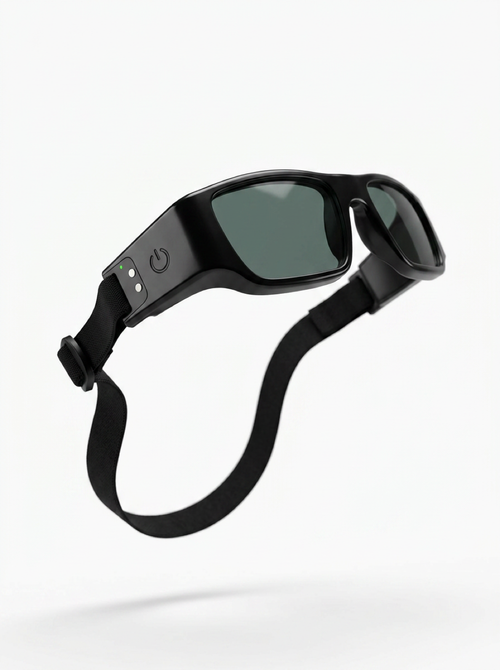
Quick answer: strobe glasses alternate clear and opaque phases at an adjustable rate. Worn during a technical drill, they force the brain to work with less visual information. A 2026 meta-analysis of 17 studies reports, after a program lasting several weeks, accuracy improved by about 5.7% and reaction time reduced by about 5.3%[1]. The typical protocol: 10 to 15 minutes per session, 2 to 3 times a week, on skills already mastered. Powereact strobe glasses cost €149.99.
The lenses of strobe glasses are liquid crystal screens that switch from clear to opaque several times per second. The longer the opaque phase, the fewer images the eye receives, and the harder the drill. You’re not training the eye as a sensor, but the whole system that turns what you see into a decision and a movement.
What are strobe glasses used for?
Strobe glasses are used to train the visual and perceptual skills used in sports:
- Anticipation: predicting the trajectory of a ball or an opponent’s movement with fewer images.
- Visuomotor reaction time: triggering the response earlier.
- Hand-eye coordination: keeping a precise movement despite incomplete information.
- Visual focus: staying focused on the useful information.
The principle is overload: you make the task harder in training so it feels easier afterward. In the moment, performance drops, and that’s normal: studies measure a drop in accuracy and reaction time while wearing the glasses[1].
Strobe glasses: do they really work?
The evidence has grown considerably stronger in recent years. Here are the most useful studies for a coach:
| Study | Population and protocol | Result |
|---|---|---|
| Vera et al., 2026 (meta-analysis)[1] | 17 studies | After training: accuracy +5.7%, reaction time −5.3% |
| Hülsdünker et al., 2021[2] | 32 young elite badminton players (mean age 13.7), 10 weeks | Visuomotor reaction time: 251 → 238 ms, still 241 ms six weeks after stopping. Control group unchanged. |
| Zwierko et al., 2023[3] | 50 volleyball players aged 16, 6 weeks | Gain in complex reaction speed clearly greater than in the control group; motor time still improved 4 weeks later |
| Wilkins & Gray, 2015[4] | 30 athletes, 9 sessions of 20 min over 6 weeks | The athletes whose perception improved were also those whose ball catching improved |
| Appelbaum et al., 2012[5] | Adults, throw-and-catch drills | Better short-term visual memory, maintained for at least 24 h |
Two honest caveats. First, a 2025 meta-analysis (9 studies, 323 athletes) confirms the effect on reaction time, but finds no significant effect on decision-making[6]. Second, wearing the glasses degrades performance in the moment: gains only appear with programs of several sessions[1]. Another meta-analysis (13 studies) shows that session frequency is the only parameter that predicts the size of the gain: not age, not experience, not program length[7].
How to use strobe glasses: the protocol
The protocol below follows the guidelines published by the German Badminton Federation with researcher Thorben Hülsdünker, following a 10-week project[8]:
| Parameter | Recommendation |
|---|---|
| Duration per session | 10 to 15 minutes of actual work |
| Frequency | 3 sessions per week, 30 to 45 minutes in total |
| Program length | 10 weeks in the federation’s project |
| Format | Intervals of 2 to 3 minutes, ideally in pairs |
| Starting level | Individual: at least 60 to 80% successful actions on the entry test |
| Progression | Increase difficulty (rate, occlusion duration) as you progress |
| Drills | Only skills already mastered, without strong head rotations |
| Athlete’s condition | No glasses when fatigued at the start of the cycle |
Schedule sessions after the warm-up, early in training, when the athlete is fresh. Avoid contact situations. The 2025 meta-analysis, for its part, found the best effects with 1 to 2 sessions of 10 minutes per week[6]: if your schedule is packed, two short, regular sessions are better than three irregular ones.

What does a typical strobe training session look like?
A 15-minute session, built into a soccer or tennis player’s training:
- 3 minutes without glasses: the chosen drill (for example, one-touch passes at 8 m), to set the baseline.
- 3 blocks of 2 to 3 minutes with glasses, at the level that lets you succeed on 60 to 80% of actions, with 1 minute of rest between blocks.
- 2 minutes without glasses to finish: most athletes then describe the game as feeling “slower” and easier to read.
Note the success rate for each block. A simple rule, to adapt: when it exceeds 80% two sessions in a row, move up a level; if it drops below 60%, go back to the previous level. To objectively measure the effects on reaction, regularly measure reaction time with a fixed test, and compare it with the average reaction time for your category.
What drills can you do with strobe glasses?
- Soccer: first touches and one-touch passes with a partner, then juggling. For goalkeepers, catching medium-power shots.
- Tennis, padel, badminton: baseline rallies at a moderate pace, volleys at the net.
- Basketball: two-handed passes, heads-up dribbling, shots close to the basket.
- Combat sports: focus mitt work, slipping on called strikes.
- All sports: throwing and catching a tennis ball against a wall, the basic drill used in studies.
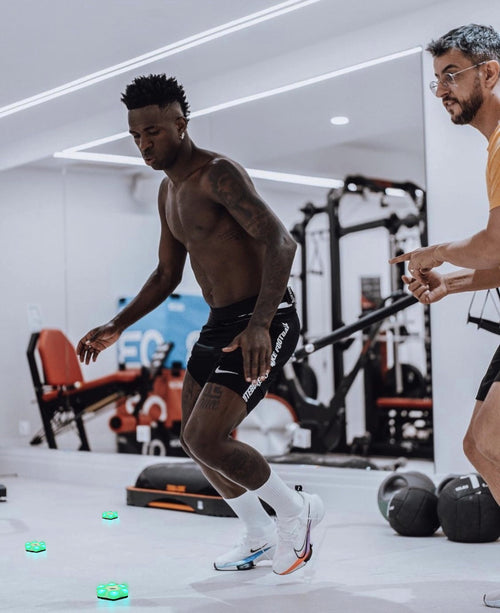
To go further, combine the glasses with reaction lights: the athlete has to spot the right color with intermittent vision. That’s what the Perception Pack is for. Our drills to improve reaction time can all be adapted with the glasses.
What precautions should you take before using strobe glasses?
Strobe glasses are a training tool, not a medical device. The German Badminton Federation excludes athletes with epilepsy, migraines or neurological disorders[8]. The Senaptec manual advises against use by people prone to seizures or blackouts, and calls for stopping immediately in case of dizziness, disorientation or involuntary movements[9]. Never wear them while driving or in a contact situation.
Which strobe glasses should you choose (Senaptec, Nike, Powereact)?
Compare the adjustable rate (number of levels), occlusion modes (both eyes, one eye, alternating), battery life, the app and the price. Senaptec, widely used in studies, is adjusted by levels and modes[9]. Powereact strobe glasses offer 4 modes, including one eye, both eyes simultaneously and heads-up vision, an adjustable rate, up to 6 hours of battery life and a free app, for €149.99. The Elite Pack (from €698.99) combines them with the reaction lights and the Jump Gate. Our comparison of Senaptec, Nike Vapor Strobe and alternatives details market prices.
Frequently asked questions
How long does it take to see results with strobe glasses?
Studies that measure an effect most often use programs of 6 to 10 weeks[2][3], with 2 to 3 sessions per week. Also allow two to three adaptation sessions before increasing difficulty.
Do physical therapists use strobe glasses?
Yes, in return-to-play training, to rework hand-eye coordination and confidence on technical movements, at progressive intensity. The protocol remains the clinician’s.
At what age can you use strobe glasses?
Several studies have been conducted with teenagers aged 13 to 16. Start at the easiest rate, with short sessions, under a coach’s supervision.
Are strobe glasses bad for your eyes?
They don’t project light into the eye: they block vision intermittently. The main precaution concerns people sensitive to flashing stimuli (epilepsy, migraines).
Sources (accessed October 10, 2026)
- Vera J., Cantó-Cerdán M., García-Ramos A., Redondo B. (2026, online December 2025), Journal of Sports Sciences, 44(5), 604–615
- Hülsdünker, Gunasekara & Mierau (2021), Medicine & Science in Sports & Exercise
- Zwierko et al. (2023), PeerJ
- Wilkins & Gray (2015), Perceptual and Motor Skills
- Appelbaum et al. (2012), Attention, Perception, & Psychophysics
- Wang R. et al. (2025), Frontiers in Psychology
- Wang Y. et al. (2026), Journal of Sports Sciences, 44(4), 460–476
- Deutscher Badminton-Verband — guidelines for stroboscopic training
- Senaptec Strobe — user manual