Looking for a FitLight alternative because the system interests you, but its dollar price is holding back your club, your clinic or your personal budget? That is the most common situation. FitLight is a serious system: its lights detect motion without contact, it requires no subscription and it appears in many scientific studies. But a kit of 4 lights costs $999, before import costs. This article does not rerun the FitLight vs BlazePod showdown. It answers a different question: if you want FitLight's contactless detection for field use, how much can you save, and what do you give up in return? You will find the price per light, a field comparison, what studies and user reviews say, then a grid to help you choose. Data collected on October 20, 2026.
In short: FitLight costs $999 for 4 lights and $1,999 for 12, excluding duties, VAT and shipping to France, as of October 20, 2026. Powereact reaction lights cost €319.99 for 4 and €839 for 12, with the same contactless detection logic (motion, plus vibration) and a free app. FitLight keeps the edge on range (50 to 75 m vs 40 m) and use in the rain.
FitLight price: how much does a FitLight Trainer cost in France?
FitLight lists its prices in dollars on its official website[1]: $999 for 4 lights, $1,199 for 6, $1,349 for 8 and $1,999 for 12. The brand recommends 4 to 6 lights for individual use and 8 to 12 for a group. For delivery to France, you need to add shipping, VAT and possible customs duties. We did not find a French reseller listing a price in euros as of October 20, 2026.
The useful calculation for a club is the price per light:
| Kit | FitLight (website price, excl. import) | Price per light | Powereact (incl. VAT) | Price per pod |
|---|---|---|---|---|
| 4 | $999 | $249.75 | €319.99 | €80.00 |
| 6 | $1,199 | $199.83 | €419.99 | €70.00 |
| 8 | $1,349 | $168.63 | €519.99 | €65.00 |
| 12 | $1,999 | $166.58 | €839 | €69.92 |
A strong point for FitLight: its app has no subscription[1]. The upfront cost is high, but it does not climb over the years. To see how FitLight compares with other brands and with subscription-based options, see our FitLight vs BlazePod comparison.
Contactless detection: what you keep with an alternative
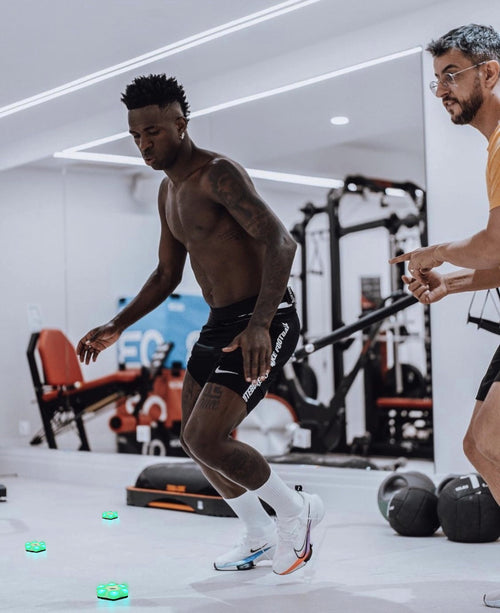
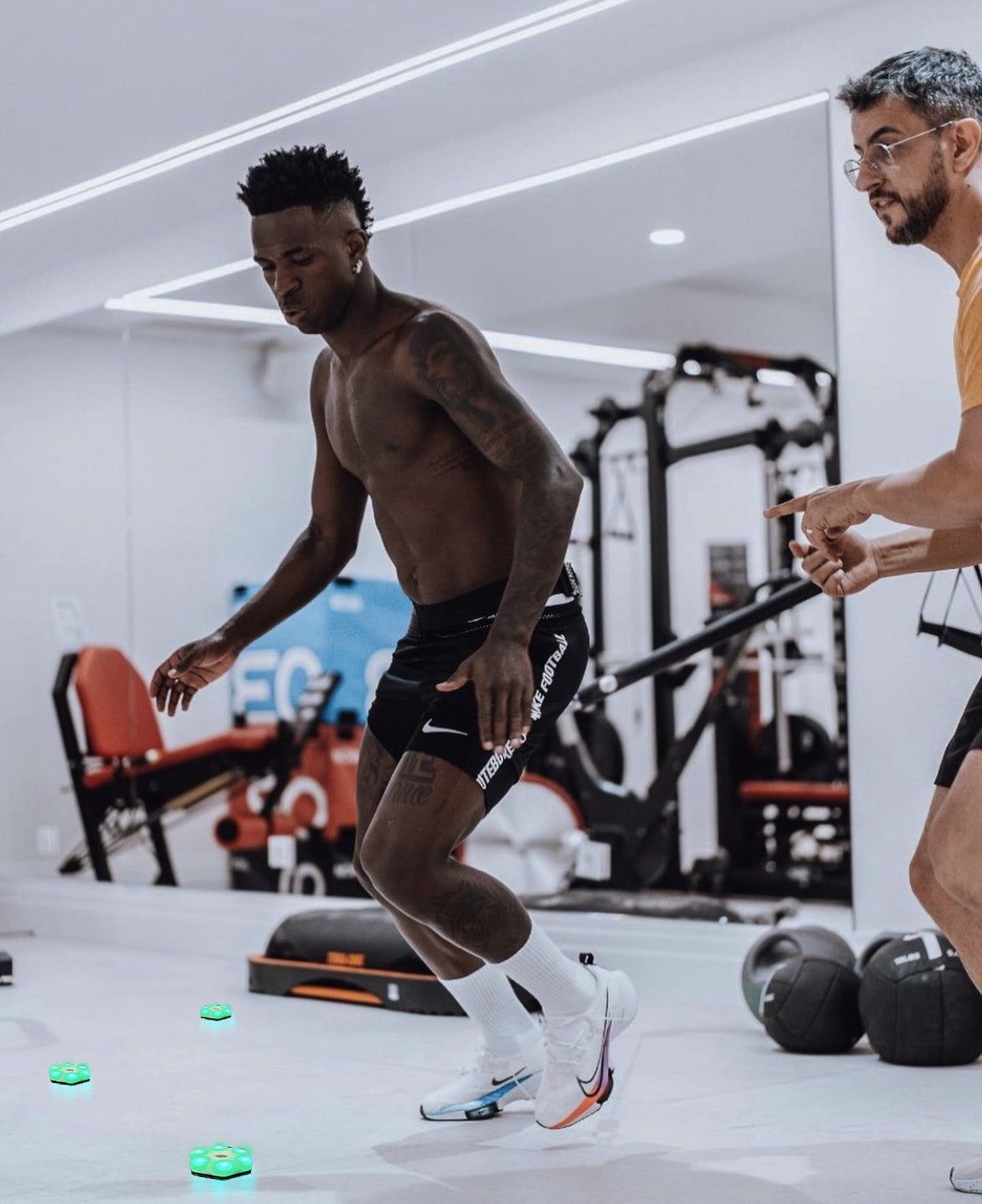
The main reason to choose FitLight is its detection. Its lights turn off with a motion at an adjustable distance of 10 to 80 cm, or on touch with three sensitivity levels[1]. On the field, this lets you validate a target with the foot, with a ball or with a slow gesture in rehab, without hitting the light.
A Powereact pod follows the same logic with two sensors: a motion sensor, which detects a hand or foot passing nearby, and a vibration sensor, which detects an impact (tap, ball). Contact is therefore not required. Each response is timestamped to the millisecond.
What changes: the detection distance cannot be adjusted in the same way. FitLight offers fine adjustment in centimeters, useful for standardized research protocols. For a field drill, what matters is that the athlete validates the target within their real movement, without bending down to a light on the ground. Both systems allow this. If you are still unsure about the concept, the guide to reaction lights for sports details the five selection criteria.

FitLight Trainer or Powereact lights: the field comparison
| Field criterion | FitLight | Powereact |
|---|---|---|
| Range | 50 to 75 m[1] | Up to 40 m |
| Connection | Wi-Fi or Bluetooth[1] | Bluetooth |
| Rain | “Water-resistant,” no published rating[1] | Not waterproof: use in dry weather |
| Battery life | Not published[1] | 30 h of continuous use |
| Simultaneous players | Up to 4[1] | Multiplayer mode |
| Ready-made drills | More than 30, in 8 categories[1] | 7 preset programs + custom drills |
| Mounting | Velcro included[1] | Velcro straps, zip ties, suction cups included |
| Data | Results saved and viewable[1] | History, profiles, PDF and CSV export, French-language app |
Two points deserve your attention. If you work on a large field, more than 40 m from the phone, FitLight has the edge. If you often train in the rain, FitLight again, since Powereact pods are designed for use in dry weather. For a gym, a training room, a clinic or a field in dry weather, the difference in range and water resistance matters little. Finally, FitLight states that its current generation is not compatible with systems prior to 2024[1]: check this if you already own older lights.
FitLight reviews: what studies and users say
FitLight has a rare advantage: it has been studied independently. These studies cover the measurement tool and reaction light training in general.
- Reliability: in 24 young volleyball players aged 11 and a half on average, a FitLight reaction test showed fair reliability between trials (ICC up to 0.784) and better reliability between sessions (up to 0.863). The first run was slower: a classic learning effect[2].
- Training: in 20 young basketball players, a reactive agility program with FitLight improved visual reaction time more than in the control group[3].
- Combat sports: in 16 boxers from a national team, 12 weeks of FitLight drills reduced arm reaction time by about 20%, vs 6.5% in the control group. The sample is small and the paper contains inconsistencies in its numbers[4].
On the user side, the brand's website quotes professional basketball strength coaches, combat sports coaches and physical therapists[1]. These results apply to the principle of reaction lights, not to a specific brand. The practical lesson: do a familiarization trial before any baseline test. To interpret your numbers, see our benchmarks on average reaction time by age and sport.
Which FitLight alternative should you choose for your budget?
| Your budget and use | Most logical option |
|---|---|
| Under €350, solo athlete or personal coach | Powereact 4 pods (€319.99) |
| About €500, club or physical therapist, group stations | Powereact 8 pods (€519.99) |
| Under €1,000, academy, large stations | Powereact 12 pods (€839) |
| Over €1,000, large field, frequent rain, research protocols | FitLight |
| Over €3,000, symbol display and timing gates | Witty SEM (Microgate) |
For the high end, our comparison of Microgate's Witty SEM reaction lights details prices and specs. Beyond 8 pods, check your phone's compatibility: some Android phones limit the number of Bluetooth devices connected at the same time.
Also in our reaction and reaction lights series
Conclusion
FitLight remains a benchmark: adjustable detection, 50 to 75 m range, subscription-free app and scientific validation. Its price, from $999 for 4 lights excluding import costs, mostly reserves it for well-equipped centers. If your use is the field in dry weather, the gym or the clinic, an alternative like Powereact keeps contactless detection for €319.99 for 4 pods, with 30 h of battery life and a French-language app, no subscription. The right choice depends mostly on your useful range and your weather conditions. To get started, compare the Powereact kits of 4, 6, 8 or 12 pods.
Frequently asked questions
What is a cheaper alternative to FitLight?
Powereact reaction lights also detect motion without contact, with an added vibration sensor. They cost €319.99 for 4 pods and €839 for 12, with a free app and no subscription. Their range is 40 m and they are designed for use in dry weather.
Is FitLight sold in France?
As of October 20, 2026, we did not find a French reseller listing a price in euros. The official website lists prices in dollars: you need to add shipping, VAT and possible duties for delivery to France. Ask for a complete quote before ordering.
Does FitLight require a subscription?
No. The official website states that the FitLight app has no subscription and is available on the App Store and Google Play. It offers more than 30 preset drills in 8 categories, custom drill creation and up to 4 simultaneous players.
Can you use FitLight lights with another app?
No. Each reaction light system works with its own app. FitLight also states that its current generation is not compatible with systems prior to 2024. Powereact pods can only be controlled with the Powereact app.
Sources (accessed October 20, 2026)
- FitLight Training — official website (prices, specs, app)
- Lima et al. (2021), Polish Journal of Sport and Tourism: reliability of a FitLight reaction test in young volleyball players
- Hassan, Alhumaid & Hamad (2022), Sports: young basketball players and FitLight
- Bendo, Bushati & Bushati (2025), Journal of Physical Education: boxers and light-based training
FitLight is a registered trademark of its owner. Comparison based on publicly available information as of the date indicated.