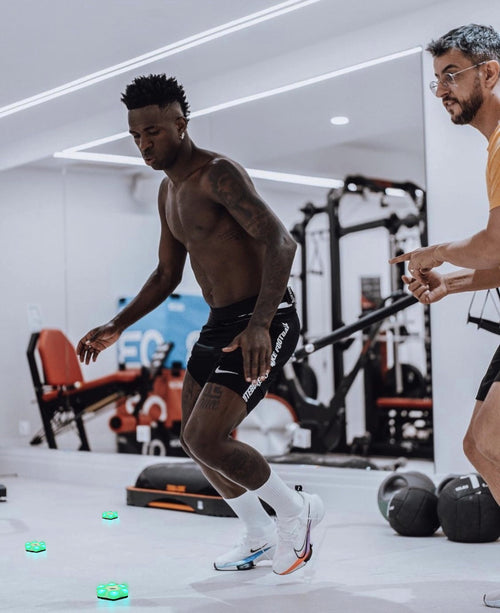
Reaction lights for boxing, tennis or padel meet a shared need: react fast to a signal, then produce the right movement. A boxer has to read an opening and strike before it closes. A tennis or padel player has to recover and push off on the right side the moment the opponent hits. A badminton player has to cover six zones of the court in fractions of a second. Reaction training lights turn these situations into measurable drills: the target lights up at random, the athlete responds, and every response is timed. This article offers reflex drills by sport (boxing, MMA, tennis, padel, badminton), ways to mount the lights on a wall, a bag or a net, recommended dosage and what studies say about reaction training in these sports.
Quick answer: in combat sports, mount 3 to 4 lights on the wall or on a bag, at face and torso height, and strike only the target color. In racket sports, place 4 to 6 lights at the corners of the court and work on recovery with the racket in hand. Sets of 20 to 30 seconds, rest at least twice as long, early in the session.
Reflexes in boxing and racket sports: what the studies say
In opposition sports, experts’ advantage isn’t just faster reflexes, but better reading of the game. A meta-analysis published in 2022 on combat sports shows that expert fighters respond faster and more accurately than non-experts, and that the gap is wider when the test situation gets closer to a real fight[1].
Can it be trained? The data are encouraging, on small samples. In 16 boxers from a national team, 12 weeks of drills with reaction lights reduced arm reaction time by about 20%, versus 6.5% in the group doing regular training, with an increase in punch frequency[2]. The sample is small (8 boxers per group) and the paper contains inconsistencies in its figures: these results should be read with caution.
In tennis, an older but often cited study showed that a short perceptual training program improved anticipation speed in less experienced players, with transfer to the court[3]. The common lesson: reaction training works better when it stays close to the actual movement and game situation. For the general principles, see our guide to reaction lights for sports.
Reaction lights for boxing and MMA: 4 reflex drills
1. Strike the target color
3 lights on the wall, at face and torso height. The boxer, in guard, strikes only the green light; red is a trap. Trigger it with a controlled movement nearby or a light touch: the pod detects movement and vibration, no need to hit hard. 3 sets of 30 seconds.
2. Slip and counter
2 lights on the wall on either side of the head. When a light turns on, the boxer slips to the opposite side, then triggers the light with a counter. 3 sets of 20 seconds, 60 seconds of rest.
3. Combinations on the bag
3 lights attached to the bag with Velcro straps or zip ties: head, left body, right body. The boxer throws a two-punch combination to the lit zone. Keep the strikes about speed rather than power to protect the pod.
4. MMA: reaction and level change
1 light high on the wall, 1 light on the floor. High: strike. Low: level change and takedown entry toward the floor light. 4 sets of 6 signals. Goal: choose the right type of response.
These drills fit early in the session, after the warm-up, or between two technical rounds. Multiplayer mode also allows head-to-head duels between two fighters on the same wall.
Tennis and padel reaction training: recovery and first step
5. Tennis: cross-pattern recovery
4 lights in a cross, 3 m from the center of the baseline. Racket in hand, the player does a small split-step at the center, moves toward the lit light, simulates a forehand or backhand while triggering the light with the racket, then returns to the center. 3 sets of 25 seconds.
6. Tennis: reflex volley
2 lights attached to the net posts with zip ties. At the net, the player reacts to the lit light with a forehand or backhand volley motion. Add a partner who feeds a ball right after the signal. 4 sets of 6 signals.
7. Padel: defense and wall exit
Lights attached to the back and side glass walls with mounting suction cups, at hip height. The player moves toward the glass whose light turns on, simulates the wall exit shot and returns to the center of their half of the court. 3 sets of 30 seconds. Padel glass is an ideal surface for suction cups.

Badminton: cover the six zones of the court
8. The six corners
6 lights on the floor in the six classic badminton zones: two at the front near the net, two in the middle on the sides, two at the back. The player starts from the center, moves toward the lit light, triggers it with the foot or racket at the end of the lunge, then returns to the center. 3 sets of 30 seconds, 90 seconds of rest.
9. Front or back: choice reaction
2 lights at the front, 2 at the back. Green: move forward and lunge. Blue: move back and simulate a smash. Every direction error is counted by the app. 3 sets of 12 signals.
In badminton, lunge quality matters as much as speed. If the knee caves inward on arrival, reduce the distance or the pace of the signals. The same progression logic is used in physical therapy rehab for athletes returning from injury.
Mounting the lights on a wall, a bag or a net
| Surface | Mounting option | Sport |
|---|---|---|
| Glass, mirror, tiles | Suction cups | Padel, boxing (mirror), training room |
| Heavy bag, dummy | Velcro straps or zip ties | Boxing, MMA, kickboxing |
| Net post, stake | Zip ties | Tennis, badminton, volleyball |
| Floor | Placed directly | All movement-based sports |
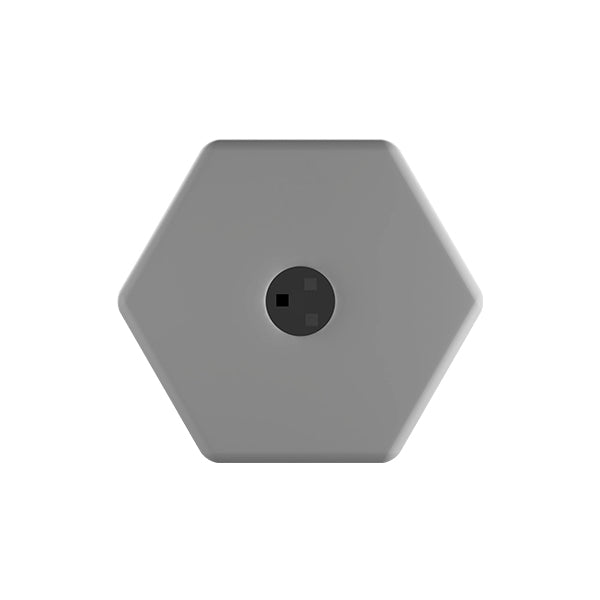
The Powereact kit includes Velcro straps, zip ties and suction cups. Extra suction cups sell for €27.99 for 4. Three practical tips:
- clean the surface before applying a suction cup, and check that it holds before the session;
- in boxing, favor a quick, controlled movement: the pod detects movement and vibration, it doesn’t need to be hit with power;
- keep the phone within 40 m of the lights, and outdoors, train in dry weather.
To track progress, choose a baseline drill (for example no. 1 in boxing or no. 8 in badminton) and repeat it every 2 to 4 weeks under the same conditions. Read the average time together with the number of errors. For a team sport, our article on reaction light drills for soccer applies the same method.
Also in our reaction and reaction lights series
- BlazePod alternative: the comparison (price, subscription, detection)
- How to improve reaction time: 5 drills with reaction lights
- FitLight vs BlazePod: the comparison, and the alternative for under €320
- Average reaction time: values by age and sport, and how to measure it
- Witty SEM alternative: comparing Microgate reaction lights
Conclusion
In boxing, MMA, tennis, padel and badminton, reaction lights train the same chain: perceive, decide, act, with a sport-specific movement. Mounted on a wall, a bag or a net, or placed on the floor, they allow short, dosed and measured drills. Studies point in the right direction, on small samples: the key is to stay close to the real movement and track a baseline drill. To get started, a kit of 4 Powereact reaction lights costs €319.99, with suction cups, Velcro straps, zip ties and a free app, no subscription.
Frequently asked questions
How do you improve reflexes for boxing?
Work on choice reaction, as close to a fight as possible: strike only the target of one color, slip then counter, throw combinations to the indicated zone. Short sets of 20 to 30 seconds, early in the session, tracking average time and errors, give the most useful benchmarks.
Can you punch a reaction light in boxing?
A quick, controlled movement is enough. Powereact pods detect nearby movement and vibration: there’s no need to hit with power. For powerful combinations, attach the lights to the bag instead, next to the striking zone.
What are good tennis reaction drills with lights?
Cross-pattern recovery with a split-step, the reflex volley with lights on the net posts, and movements to the corners of a reduced court. Keep the racket in hand and simulate the stroke to stay close to the game.
How do you mount a reaction light on a wall?
On a smooth surface (glass, mirror, tiles), use suction cups. On a rough wall, attach the lights to a support instead: wall bars, a bag, a post, with Velcro straps or zip ties. Always check that it holds before starting the session.
Sources (accessed October 20, 2026)
- Zhang et al. (2022), Frontiers in Psychology: perceptual anticipation in combat sports experts, meta-analysis
- Bendo, Bushati & Bushati (2025), Journal of Physical Education: reaction time and punch frequency in boxers
- Williams et al. (2002), Journal of Experimental Psychology: Applied: anticipation training in tennis