Strobe glasses for tennis, padel and badminton train what happens in a few tenths of a second: reading the trajectory of the ball or shuttle, getting into position, hitting. By cutting off vision intermittently, they force the player to anticipate with fewer images. But not every drill is suited to them. A service return, for example, depends on a very brief movement by the opponent: if the opaque phase falls at the wrong moment, the drill becomes impossible. This article draws on studies conducted in racket sports and on the recommendations published by the German Badminton Association following a 10-week project. You will find the drills to favor, the ones to avoid, starting settings and a progression table for each of the three sports.
In short: in 32 young elite badminton players, 10 weeks of strobe training reduced visuomotor reaction time from 251 to 238 ms[2]. In tennis, a 2023 study shows that volley accuracy drops from 70 to 54.5 points even at the easiest level[3]: so you need simple drills and gradual settings. Powereact strobe glasses cost €149.99.
Why train vision in racket sports?
In racket sports, the ball or shuttle changes direction on every shot. The player must read the trajectory very early to prepare their movement. A padel study using a mobile eye tracker recorded the gaze of 8 national-level players during real rallies. The ball accounted for about 80% of fixations and 90% of fixation time, and players tracked the ball continuously, from the opponent's racket to their own shot[4]. The sample is small, but the idea is clear: in racket sports, vision is almost entirely devoted to the ball.
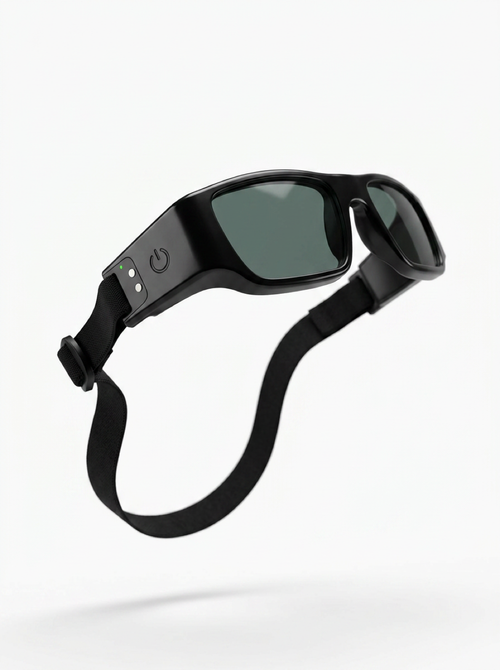
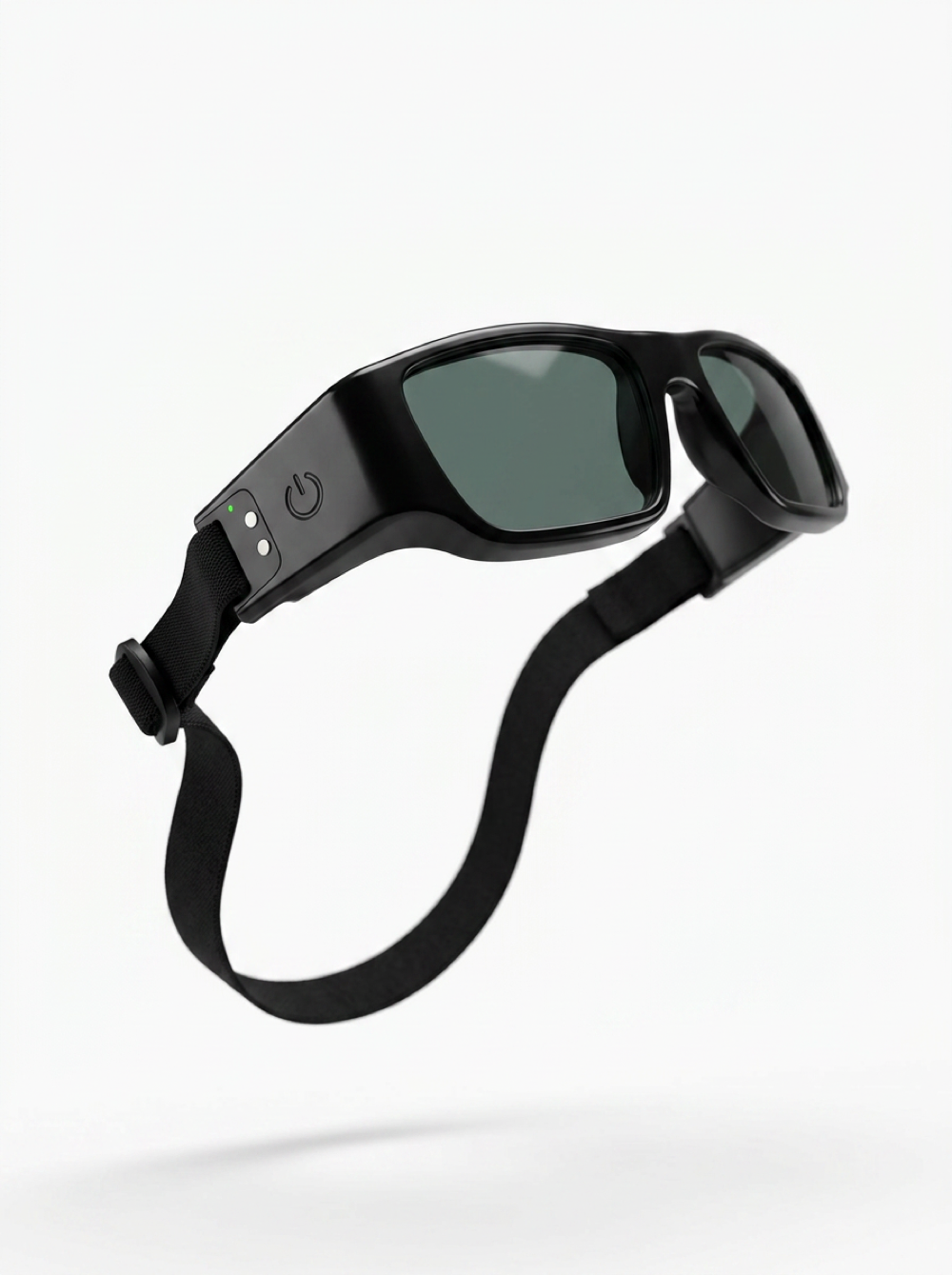
Strobe glasses remove part of this information. The player has to predict the trajectory between two images, which challenges anticipation and visual processing speed. The general principle and the research findings are detailed in our guide strobe glasses: what they are for and how to use them. Here, we focus on applying them to the three racket sports.
What studies say in badminton and tennis
Badminton: a measured, lasting effect
The landmark study followed 32 young elite badminton players, aged 13.7 on average, for 10 weeks. The trained group's visuomotor reaction time dropped from 251 to 238 ms, and was still 241 ms six weeks after training stopped. The control group did not improve[2]. This project served as the basis for the German Badminton Association's recommendations[1].
Tennis: an immediate drop in accuracy
A 2023 study measured the accuracy of 25 forehand volleys hit toward a target, in 22 tennis players, with and without glasses[3]:
| Condition | Opaque phase | Accuracy score (points) |
|---|---|---|
| Without glasses | — | 70.0 |
| Easy level (5.3 Hz) | about 88 ms | 54.5 |
| Medium level (2.3 Hz) | about 341 ms | 41.7 |
| Hard level (1.0 Hz) | about 909 ms | 44.5 |
This study does not measure a training effect, but the immediate effect of wearing the glasses. It shows that even the easiest level clearly reduces accuracy, and that beyond it, differences between players increase. That is a strong argument for starting at the lowest level. The gains, for their part, only appear after several weeks: the 2026 meta-analysis of 17 studies reports reaction time reduced by about 5.3% after a complete program[5].
Recommended drills, drills to avoid
The German Badminton Association drew a list of principles from its project[1]. The first: reduce the quantity of visual information, not its quality. Some information is critical and cannot be compensated for if it falls during the opaque phase, such as the opponent's brief serving motion. So you need standardized drills, with shot sequences defined in advance.
| Favor | Avoid |
|---|---|
| Half-court situations | Free play on the full court (1 vs 1, 2 vs 1) |
| Doubles defense on announced shots | Neutralizing drills |
| Drive sequences | Complex game formats |
| Mid-court and net play, at a fast pace | Drills with repeated head and trunk rotations |
| Technically mastered strokes | Learning a new stroke |
The association also recommends drills that require fast reactions (short distances, high pace), because reaction speed is what strobe training improves. The coach should be able to measure the success of each drill, for example by counting errors[1].

Drills by sport: tennis, padel, badminton
Tennis
- Net volleys on fed balls: the coach feeds at a steady pace, forehand then backhand. 3 blocks of 2 minutes.
- Mini-tennis in the service boxes: controlled rallies in pairs, goal of 10 shots without an error.
- Simplified service return: to work on service return anticipation, start with a hand-fed serve or a second serve placed in an announced zone. The real serve, too brief, is critical information as defined in the recommendations[1].
Padel
- Crosscourt volley exchanges at the net, in pairs, without lobs.
- Bajadas and wall exits: reserve these for players used to the glasses, as they involve pronounced head rotations.
Badminton
- Drives in pairs at mid-court, fast pace.
- Doubles defense on smashes announced by the coach.
- Net push play, fixed sequences.
In badminton, seeing the shuttle at the end of its trajectory is essential: keep distances short and trajectories flat at first.
Starting settings and progression
The recommendations propose an entry test: set the difficulty so that the player succeeds on 60 to 80% of their actions, then increase it as they improve[1]. Sessions last 10 to 15 effective minutes, 3 times per week, in intervals of 2 to 3 minutes, ideally in pairs so players can alternate[1].
| Phase | Tennis | Padel | Badminton |
|---|---|---|---|
| Weeks 1 and 2 | Volleys on fed balls | Crosscourt volleys | Mid-court drives |
| Weeks 3 and 4 | Mini-tennis, +1 level | Volleys + announced smash | Doubles defense |
| Weeks 5 and 6 | Return on placed serve | Simple wall exits | Fast net play |
| In each phase | Move up one level above 80% success, move down below 60% | ||
Two safety rules from the association: no glasses for players with epilepsy, migraines or neurological disorders, and no wearing them while fatigued at the start of a training block[1]. If the player changes their technique to compensate, lower the level. The same framework applies to team sports: our article on strobe glasses for soccer offers a 6-week protocol.
Also in our vision and perception series
Conclusion
In tennis, padel and badminton, strobe glasses are used to train ball reading and reaction speed. The landmark badminton study measured a 13 ms gain in visuomotor reaction time after 10 weeks, partly retained six weeks later. The main rule: standardized drills, on half-court, with mastered strokes and 60 to 80% success. Powereact glasses are adjusted from the free app, so you can change the level between two blocks without stopping the session.
Frequently asked questions
Are strobe glasses useful for tennis?
They help train anticipation and reaction speed on simple drills such as volleys or mini-tennis. Tennis-specific studies are still few; the strongest data comes from badminton and from meta-analyses across all sports.
How do you improve anticipation on the service return?
First work without glasses, on video or on court, on reading the toss and the racket orientation. With glasses, use hand-fed serves or serves placed in an announced zone, because the serving motion is too brief to be read with intermittent vision.
Can you play a match with strobe glasses?
It is not recommended. The German Badminton Association advises against free play on the full court and complex game formats. Keep the glasses for drills with shot sequences defined in advance.
What is the difference between strobe glasses and NeuroTracker for badminton?
The glasses are used on the court, during the shot. NeuroTracker is an object-tracking exercise on a screen, with no sport movement. Our article on the NeuroTracker alternative compares the two approaches.
Sources (accessed October 20, 2026)
- Deutscher Badminton-Verband, Hülsdünker T., Käsbauer H. — recommendations for strobe training
- Hülsdünker T., Gunasekara N., Mierau A. (2021), Medicine & Science in Sports & Exercise
- Jendrusch G., Binz N., Platen P. (2023), OCL — shutter glasses in tennis
- Espino Palma C. et al. (2023), Sensors, 23(3):1438
- Vera J. et al. (2026), Journal of Sports Sciences, 44(5)