Looking for a NeuroTracker alternative to train your athletes' vision and attention? Before comparing, you need to know what this tool actually does. NeuroTracker is 3D multiple object tracking software: the athlete, seated in front of a screen with 3D glasses, tracks moving spheres. It is a cognitive exercise, with no sport movement. Strobe glasses and reaction lights train something else: visual information gathering during the movement, on the field. So they are not the same tools, and one does not replace the other. This article presents NeuroTracker prices collected on October 20, 2026, what independent studies say about its transfer to the field, then a cognitive training protocol for sport that you can run with field equipment.
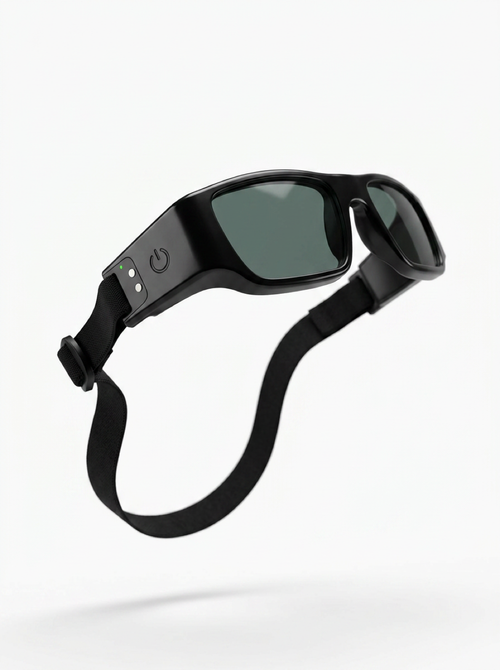
In short: NeuroTracker costs $30 per month, $20 per month on the annual plan or $700 for lifetime access, 3D glasses included[1]. A 2021 critical review concludes that evidence of transfer to real-world tasks remains weak[5]. To train vision during the movement, Powereact strobe glasses cost €149.99, with a free app and no subscription.
How does NeuroTracker multiple object tracking work?
NeuroTracker comes from the work of researcher Jocelyn Faubert at the University of Montreal. The standard task is described in detail in the review by Vater and colleagues[5]:
- 8 yellow spheres are displayed in stereoscopic 3D;
- 4 of them turn red for 2 seconds: these are the targets;
- all turn yellow again and move for 8 seconds;
- the athlete must then identify the 4 targets;
- speed adjusts on each trial to keep the task challenging.
A session lasts 6 minutes and runs on a tablet, computer or TV[2]. The publisher cites more than 120 publications and users such as Manchester United and NASA[2].
The most frequently cited study dates from 2013. Faubert compared 102 professional athletes (Premier League, NHL, Top 14), 173 amateurs and 33 non-athlete students over 15 sessions. The professionals started with a better score and progressed faster[3]. This shows a difference between groups, not an effect of training on game performance. That is a key point for what follows.
Multiple object tracking draws on sustained attention and the ability to monitor several elements at the same time. On the field, these qualities help track several opponents. But the athlete stays seated, eyes fixed on a central point, without running or touching a ball.
NeuroTracker price: how much does the subscription cost?
The individual plans published on the official website, in dollars, are as follows[1]:
| Plan | Listed price | Cost over 3 years | Included |
|---|---|---|---|
| Monthly | $30 / month | $1,080 | 1 account, 3D glasses, baseline assessment |
| Annual | $20 / month | $720 | Same, discount on family accounts |
| Lifetime access | $700 one-time | $700 | Same, updates included |
| Club plans | On quote | — | Custom programs, multiple licenses |
| Powereact glasses | €149.99 incl. VAT | €149.99 | Free app, athlete profiles |
Each individual plan covers a single account. For a club that wants to track several players, you have to go through the professional plans, whose prices are not published. The dollar amounts do not include French VAT.
The price comparison has its limits: NeuroTracker sells standardized cognitive assessment and training software, while strobe glasses are a field tool. The table mainly helps you size the investment if your goal is visual training applied to the movement.
What do studies say about NeuroTracker?
NeuroTracker's strength is its research base, larger than that of most tools on the market. The question for a coach is transfer: do gains on the screen show up on the field?
- Romeas et al., 2016: about twenty college soccer players. After 10 sessions, the trained group improved the accuracy of its passing decisions by 15%, as judged by the coach. No effect on dribbling or shooting[4][5].
- Vater, Gray and Holcombe, 2021: critical review of 29 studies, including 16 intervention studies. None was preregistered. Only three tested transfer to a real-world task, and two found no effect[5].
- Romeas et al., 2025: 62 players from a professional academy. The trained group improved clearly on the NeuroTracker task, but neither on an attention test nor on its small-sided game performance[6].
The picture is nuanced. Athletes improve on the task itself; that is established. Transfer to the game remains uncertain, and the latest study by the team that obtained the 2016 result does not replicate it. This does not disqualify the tool, but it suggests not expecting a direct effect on the field.
NeuroTracker or strobe glasses: two different tools
| Criterion | NeuroTracker | Strobe glasses |
|---|---|---|
| Where | Seated in front of a screen | On the field, during the drill |
| What is trained | Multiple object tracking, sustained attention | Information gathering and anticipation with intermittent vision |
| Sport movement | None | The usual movement (pass, volley, catch) |
| Research data | Gains on the task; uncertain transfer[5][6] | Reaction time reduced by about 5.3% (meta-analysis of 17 studies)[7] |
| Known limitation | Few transfer studies | No clear effect on decision-making[8] |
| Business model | Subscription or lifetime access | One-time purchase, free app |
Strobe glasses also have their limits: a 2025 meta-analysis finds no significant effect on decision-making[8]. Both approaches target related qualities through opposite paths. NeuroTracker isolates attention; the glasses challenge it during movement. How the glasses work and the studies on them are detailed in our guide strobe glasses: what they are for and what the science says.

Cognitive training for sport: a 4-week field protocol
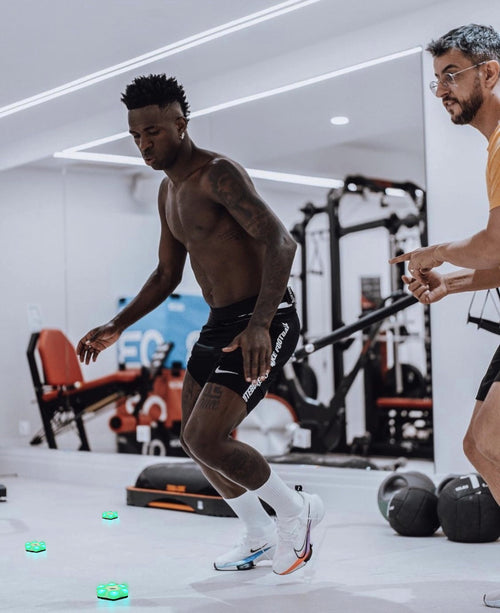
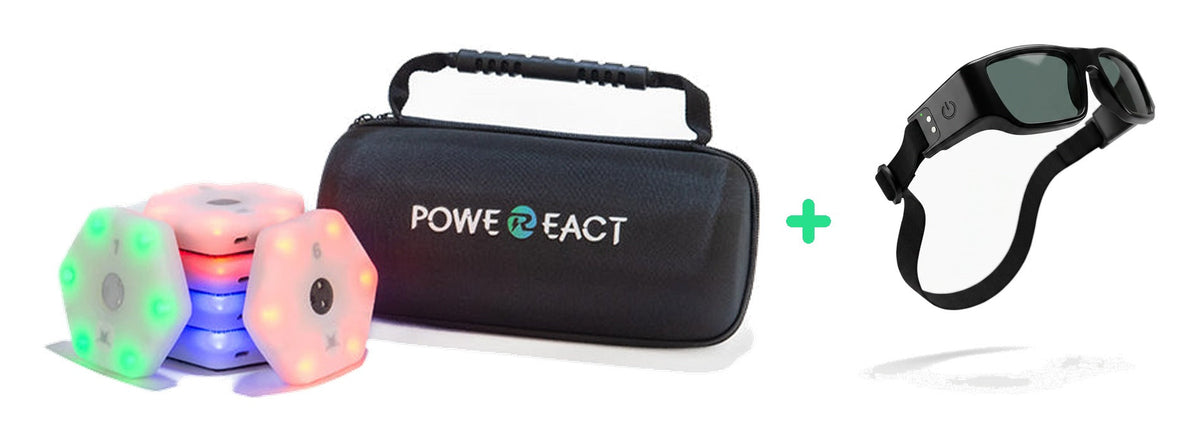
To train vision and attention with field equipment, combine two tools: the glasses to reduce visual information, and reaction lights to force a decision under time pressure. Here is a framework of 2 sessions of 15 minutes per week, to place after the warm-up:
| Week | Glasses | Reaction lights |
|---|---|---|
| 1 | Easiest level, familiar passes or catches, 3 blocks of 2 min | Simple reaction: turn off the lit light, 4 lights |
| 2 | Move up one level if success rate is above 80% | Choice reaction: a single target color |
| 3 | Same level, faster drill | Two target colors to remember, 6 lights |
| 4 | Glasses and lights together, easy level | Baseline test without glasses, compared with week 1 |
The 60 to 80% success rule comes from the German Badminton Association's recommendations, covered in our guide. The two-target-color drill reproduces on the field the idea of multiple object tracking: remembering several targets and ignoring the others. The Perception Pack (from €448.99) brings lights and glasses together in the same app, with each athlete's history and PDF or CSV export.
Conclusion
NeuroTracker is a serious, well-studied tool, useful for standardized cognitive monitoring and remote work. Its plans cost $20 to $30 per month, or $700 for lifetime access, for a single account. Independent studies show gains on the task, but transfer to the game is still uncertain. If your goal is to train vision during the movement, on the field and for several athletes, strobe glasses and reaction lights meet that need better. To choose your glasses, see our comparison of Senaptec, Nike and their alternatives.
Frequently asked questions
How much does NeuroTracker cost per month?
As of October 20, 2026, the official website lists $30 per month with no commitment, $20 per month on the annual plan, or $700 for lifetime access. A pair of 3D glasses is included. Plans for clubs and professionals are on quote.
Does NeuroTracker work for sports?
Athletes improve on the task itself. Transfer to the game is less clear: a 2021 review judges the evidence weak, and a 2025 study with 62 young professional soccer players found no effect on their small-sided game performance.
Can you do NeuroTracker without 3D glasses?
The standard task described in the literature uses a stereoscopic 3D display. Individual plans include a pair of 3D glasses. For your screen's technical requirements, check directly with the publisher.
What equipment do you need for cognitive training on the field?
Strobe glasses to reduce visual information during the movement, and reaction lights to force a fast decision. Our guide to reaction lights for sports details the basic drills.
Sources (accessed October 20, 2026)
- NeuroTracker — plans and pricing
- NeuroTracker — home page (session length, references)
- Faubert J. (2013), Scientific Reports, 3:1154
- Romeas T., Guldner A., Faubert J. (2016), Psychology of Sport and Exercise
- Vater C., Gray R., Holcombe A. O. (2021), Psychonomic Bulletin & Review, 28(5)
- Romeas T., Goujat M., Faubert J., Labbé D. (2025), Psychology of Sport and Exercise, 76
- Vera J. et al. (2026), Journal of Sports Sciences, 44(5)
- Wang R. et al. (2025), Frontiers in Psychology
NeuroTracker is a registered trademark of its owner. Comparison based on publicly available information as of the date indicated.