In short: the average reaction time of an adult is about 180 to 200 ms for a simple visual signal and 140 to 160 ms for an auditory signal[1]. As soon as you have to choose between several responses, it gets longer. It stays fairly stable until your fifties for a simple task, but slows throughout adult life for a choice task[2].
Reaction time is the delay between the appearance of a signal and the start of the response. This delay includes perceiving the signal, processing it in the brain, deciding and initiating the movement. That is why there is no single average reaction time, but several, depending on what is measured.
What is the average reaction time for adults (and what is a normal reaction time)?
| Task type | Average value | Source |
|---|---|---|
| Simple reaction to a light signal | 180 to 200 ms | Literature review[1] |
| Simple reaction to a sound signal | 140 to 160 ms | Literature review[1] |
| Simple reaction to touch | about 155 ms | Literature review[1] |
| Visual reaction measured on a computer (1,469 adults) | 231 ms (213 ms after correcting for hardware delay) | Woods et al., 2015[3] |
| Online test such as Human Benchmark | median of about 273 ms | Data published by the website[4] |
Why is sound faster than light? Because the auditory signal reaches the brain in 8 to 10 ms, compared with 20 to 40 ms for the visual signal[5]. And why do online tests give slower numbers? Because they add the delay of the screen, the mouse and the browser: they measure the human and the hardware.
What changes your number, in milliseconds
The studies below let you put a number on the effect of each factor. This is the grid to keep in mind before comparing two results:
| Factor | Measured effect | Calculation |
|---|---|---|
| Hardware delay (computer) | about +18 ms | 231 − 213 ms[3] |
| Age, from 20 to 65 (simple reaction) | about +25 ms | 45 years × 0.55 ms[3] |
| Sound rather than light | about −40 ms | 140-160 vs 180-200 ms[1] |
| Pressure of a final (sprinters) | about −19 ms | 161 ms in round 1, 142 ms in the final[13] |
The practical consequence: a 20 ms difference between two tests done on different devices proves nothing. Only an identical test, repeated under the same conditions, allows you to draw conclusions.
Why does reaction time increase with the number of choices?
This is Hick's law: choice reaction time increases with the logarithm of the number of possible responses[6]. Reacting to a single light is fast. Reacting to the right color among four, then choosing a direction, takes much longer.
That is exactly the situation in sport: a defender almost never reacts to a single signal. They must identify one piece of information among others, then choose. So it is choice reaction time that you need to measure and train in an athlete.
What is the average reaction time by age?
The largest study on the subject (7,130 adults) shows two trends[2]:
- Simple reaction time slows little until about age 50.
- Choice reaction time slows gradually throughout adult life.
Another study puts this slowdown at about 0.55 ms per year between 18 and 65, mainly because of the motor part of the response: signal detection stays stable[3]. During childhood and adolescence, processing speed improves steadily[7].
In older adults, the stakes are concrete: reactive step training programs reduce the fall rate by about half and improve step reaction time, both simple and choice[8].
Athlete reaction time: are athletes really faster?
Yes, but not where you might think. Studies show that athletes' advantage lies mainly in choice and anticipation tasks, much less in simple reaction:
| Population | Result | Source |
|---|---|---|
| Experts, 42 studies | Faster and more accurate responses to cues specific to their sport | Mann et al., 2007[9] |
| Athletes vs non-athletes, 20 studies | Slight processing speed advantage, clearer in interceptive sports | Voss et al., 2010[10] |
| Baseball and tennis players | No difference in simple reaction; advantage in “go/no-go” reaction | Kida et al., 2005[11] |
| Karate athletes | Better choice reaction than novices, identical simple reaction | Mori et al., 2002[12] |
| World 100 m finalists (men) | 142 ms on average at the start | Tønnessen et al., 2013[13] |
In sprinting, a start less than 100 ms after the gun is considered a false start[14]: the rules assume that it is impossible to react faster. At the 2003-2009 World Championships, average reaction time at the start was 166 ms for men and 176 ms for women[13].
What slows down reaction time?
- Lack of sleep: after 17 to 19 hours awake, performance is equivalent to a blood alcohol level of 0.5 g/L (0.05% BAC)[15].
- Sleep debt: sleeping 4 to 6 hours a night for two weeks degrades alertness cumulatively[16].
- No warm-up: prior exercise has a small positive effect on cognitive performance[17].
- Caffeine, on the other hand, slightly improves alertness and reaction time[18].
To compare two measurements, keep the same conditions: same time of day, same warm-up, same test.
How do you measure your reaction time reliably?
An online test gives an order of magnitude, but it measures a finger response on a screen. For an athlete, the useful measurement is a whole-body reaction, with a choice and a movement. Three rules:
- An unpredictable signal: random order and delay, otherwise the athlete anticipates.
- Several trials: keep the average of a set, not the single best trial.
- A fixed test: same number of targets, same distance, every time you measure.
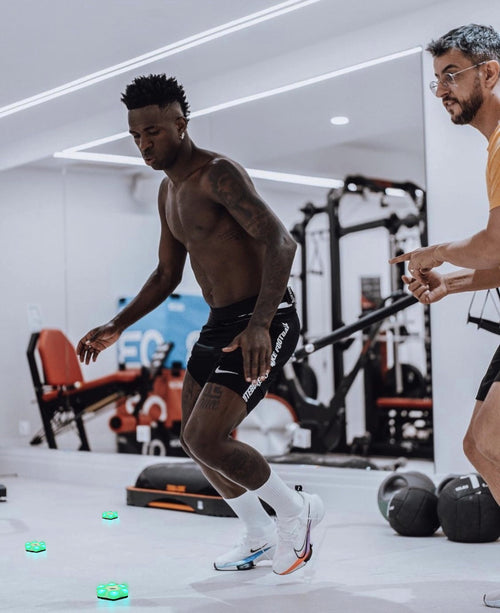
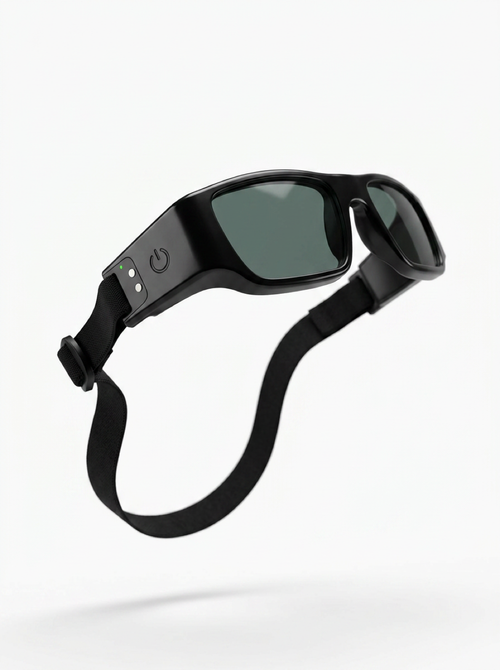
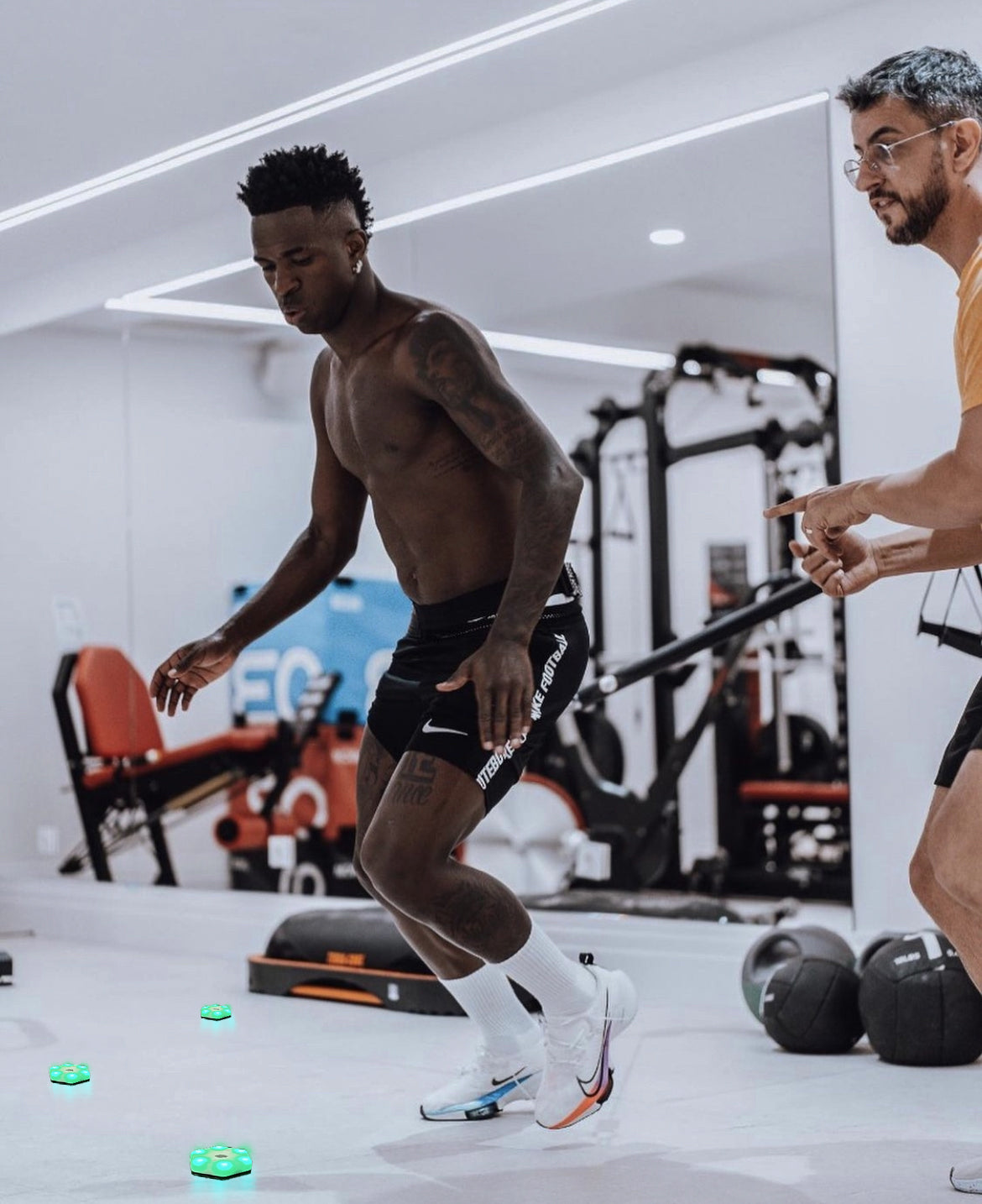
Powereact reaction lights turn on at random and timestamp each response to the millisecond, by hand or foot. The free app, with no subscription, calculates the average time, the best time and errors, and keeps each athlete's history. To turn measurement into progress, follow our 5 drills to improve your reaction time, and for visual perception, discover what the science says about strobe training, Powereact strobe glasses (€149.99) and our comparison of models (Senaptec, Nike).

Also in our reaction and reaction lights series
Frequently asked questions
What is a good reaction time in milliseconds?
For a simple reaction to light, under 200 ms is a good result for an adult. On an online test, which adds hardware delay, under 250 ms is already fast. Above all, compare yourself to yourself, on the same test.
What is the average reaction time while driving?
When driving, it is no longer a lab reaction: you have to perceive a hazard, decide and move your foot. Stopping distance calculations taught in driver's education use about 1 second, and 1 to 2 seconds depending on attention and fatigue. At 50 km/h, that represents about 14 m traveled before braking.
Can you improve your reaction time?
Simple reaction changes little. Choice reaction time, anticipation and decision quality, however, improve with specific, measured training.
Do women have slower reaction times?
The results are mixed. Some studies observe slightly shorter times in men, and in active people compared with sedentary people[5]. The large British study finds differences mainly in response variability[2], and the Woods study finds no effect of sex on simple reaction[3]. The differences remain small compared with the effects of sleep or fatigue.
Sources (accessed October 10, 2026)
- Kosinski, A Literature Review on Reaction Time (via BioNumbers, Harvard)
- Der & Deary (2006), Psychology and Aging
- Woods et al. (2015), Frontiers in Human Neuroscience
- Human Benchmark — Reaction Time Test
- Jain et al. (2015), Int J Appl Basic Med Res
- Hick (1952), Quarterly Journal of Experimental Psychology
- Kail (1991), Psychological Bulletin
- Okubo et al. (2017), British Journal of Sports Medicine
- Mann et al. (2007), Journal of Sport & Exercise Psychology
- Voss et al. (2010), Applied Cognitive Psychology
- Kida et al. (2005), Cognitive Brain Research
- Mori et al. (2002), Human Movement Science
- Tønnessen et al. (2013), Journal of Strength and Conditioning Research
- World Athletics — Book of Rules
- Williamson & Feyer (2000), Occupational and Environmental Medicine
- Van Dongen et al. (2003), Sleep
- Chang et al. (2012), Brain Research
- McLellan et al. (2016), Neuroscience & Biobehavioral Reviews