Peripheral vision in sports lets you see a teammate getting open, an opponent closing in or a ball changing trajectory without turning your head. People often talk about “widening” it, but the reality is more nuanced. The visual field itself depends on the anatomy of the eye. What sets expert athletes apart is how they distribute their attention and pick up information within that field. That is the ability you can train. This article explains what peripheral vision is, what studies on athletes show, then offers eight peripheral vision training drills: five without equipment, three with reaction lights and strobe glasses. Each drill comes with its setup, cue and dosage, so you can plug it straight into a session.
In short: the horizontal visual field reaches about 214 degrees, or 107 degrees on each side of the fixation point[1]. Expert athletes do not see farther to the sides: they distribute their attention better, with an attentional window about 25% wider than that of novices[2]. You train it with information-gathering drills: eyes fixed on the center, signals in the periphery, quick decisions.
What is peripheral vision?
Vision is divided into two zones. In the center, the fovea gives a sharp image: it is what you use to read or to lock onto the ball. Around it, peripheral vision covers the rest of the visual field. It is less precise, but it detects the presence, position and movement of objects.
The visual field is very wide. According to the clinical reference cited in a Journal of Vision review, it extends about 107 degrees on each side of the fixation point, or about 214 degrees in total horizontally[1]. Acuity, on the other hand, drops quickly as you move away from the center[1].
In sports, these two zones work together. The player fixes on a useful point (the ball, the ball carrier, the direct opponent) and monitors the rest in the periphery. When something important appears to the side, they decide whether to shift their gaze, or to react without doing so. The quality of peripheral vision in sports therefore depends less on the eye than on this distribution of attention.
A word of caution: if you notice discomfort to the sides, blurry areas or a loss of visual field, see an ophthalmologist. Sports training does not replace a medical exam.
Visual field and sports: what sets experts apart
A 2014 study measured the width of the attentional window, meaning the area in which a person perceives several pieces of information at once. Expert athletes had a window about 25% wider than novices[2]. Its shape also depended on the sport: soccer players, who need to monitor play across the width of the field, had attention spread more horizontally, volleyball players more vertically[2].
Researchers at the University of Bern described the gaze strategies that rely on peripheral vision[3]:
- Visual anchor: the gaze rests between several elements to monitor, to keep them all in the periphery. Useful in one-on-ones or in beach volleyball.
- Visual pivot: peripheral vision spots where to look next. Useful on defense in basketball.
- Foveal fixation: the gaze lands directly on the important element.
These strategies show that peripheral vision is not a passive quality. The athlete chooses where to place their gaze to make the most of what they see around them.
Can you really train your peripheral vision?
What you train is not the extent of the visual field, but information gathering. Studies on experts measure better-distributed attention, not different eyes[2]. In soccer, peripheral information is complemented by scanning: an active head movement to look around before receiving the ball. A study over one Premier League season measured an average of 0.44 scans per second, with a small but positive effect on passing success[4].
You also need to be cautious about transfer. Screen-based cognitive exercises improve performance on the trained task, but a 2021 critical review judges the evidence of transfer to real-world tasks weak[5]. We compare these tools with field work in our article on the NeuroTracker alternative.
Hence three principles for your drills:
- A central fixation point, so the information comes from the periphery.
- A decision to make: react to a color, a gesture, a number.
- A sport movement whenever possible, to stay close to the game.
5 peripheral vision drills without equipment
1. Fingers in the periphery
The athlete looks at the face of a partner standing 2 m away. The partner raises their arms to the sides and shows a number of fingers on one hand. The athlete calls out the number without taking their eyes off the face. 3 sets of 10.
2. Juggling and call-out
The player juggles the ball. The coach, standing at 45 degrees to the side, raises a colored pinnie. The player calls out the color without losing the ball. 3 blocks of 1 minute.
3. Three-player passing, fixed gaze
Three players in a triangle. The central player looks at a cone in front of them and must spot which teammate raises a hand before passing them the ball.
4. Visual anchor in a one-on-one
One defender facing two attackers. The defender fixes on the point between them and must react to the first one who takes off.
5. Scan before receiving
Before each pass received, the player must look over their shoulder and call out a number shown by a teammate standing behind them.
Drills with equipment: reaction lights and glasses
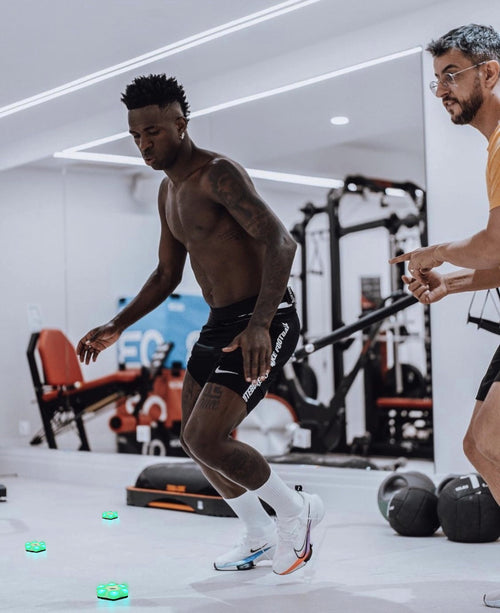
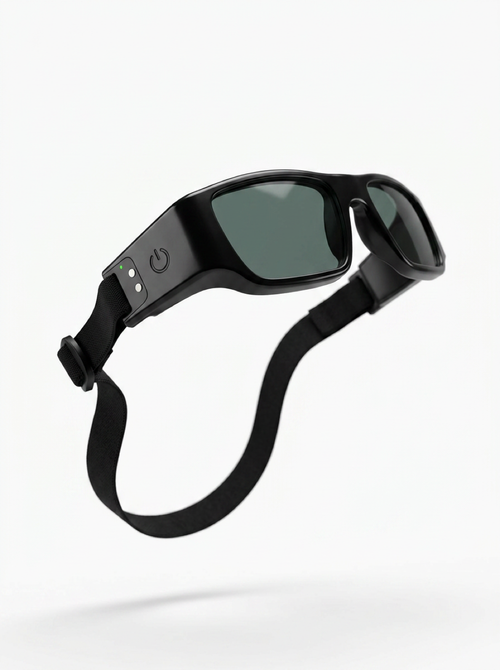
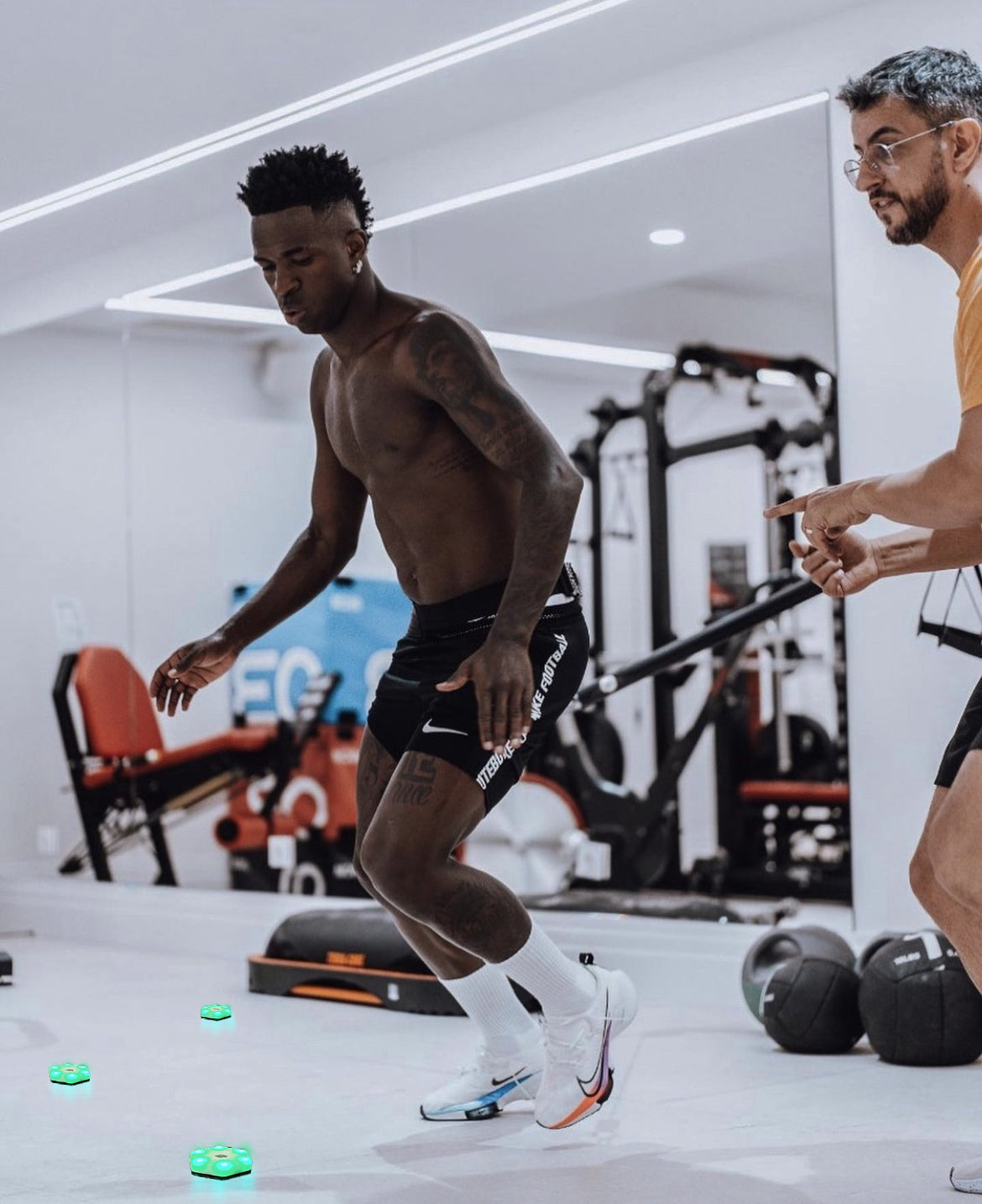
Equipment brings two things: unpredictable signals and measurement. Powereact reaction lights detect motion and measure reaction time to the millisecond; strobe glasses reduce visual information and have a heads-up vision mode.
| Drill | Setup | Cue | Dosage |
|---|---|---|---|
| 6. Arc of lights | 5 lights in a semicircle at 1.5 m, central cone | Look at the cone, turn off the lit light with the hand | 3 × 30 s, 1 min rest |
| 7. Target color in the periphery | 6 lights, 2 of them on the far sides | React to only one color, ignore the others | 4 × 30 s |
| 8. Head up with glasses | Glasses in heads-up vision mode, dribbling | Dribble without looking at the ball, call out the coach's signals | 3 × 2 min, easy level |
To track progress, keep a fixed benchmark drill (same layout, same duration) and compare the average reaction time from one session to the next in the app. The rules for using the glasses (duration, starting level, contraindications) are detailed in our guide strobe glasses: what they are for and what the science says. For sport-specific drills, see our protocols for strobe glasses in soccer and for tennis, padel and badminton.

Also in our vision and perception series
Conclusion
Peripheral vision covers about 214 degrees horizontally, but it is not its extent that makes the difference in sports. Expert athletes distribute their attention better and choose better where to place their gaze. That is what you can train, with simple drills: a central fixation point, a decision to make, a sport movement. Start with the drills without equipment, then add light signals to measure your progress. The Perception Pack (from €448.99) brings lights and glasses together in the same app.
Frequently asked questions
How do you train your peripheral vision?
Fix your eyes on a central point and react to signals that appear to the sides: raised fingers, colors, reaction lights. Add a decision (a single target color) and a sport movement. Two to three short sessions per week are enough to build it into training.
What is the normal human field of vision?
The visual field extends about 107 degrees on each side of the fixation point, or about 214 degrees horizontally. Sharp vision only covers a small central area. If you have any doubt about your visual field, see an ophthalmologist.
Do athletes have better peripheral vision?
They do not have different eyes, but better-distributed attention. A 2014 study measured an attentional window about 25% wider in expert athletes, shaped by their sport.
Do strobe glasses improve peripheral vision?
They mainly train anticipation and reaction time with reduced visual information. The heads-up vision mode forces you to lift your eyes off the ball and use your periphery more while dribbling.
Sources (accessed October 20, 2026)
- Strasburger H., Rentschler I., Jüttner M. — Peripheral vision and pattern recognition: a review, Journal of Vision 11(5) (2011), correction 24(4) (2024)
- Hüttermann S., Memmert D., Simons D. J. (2014), Journal of Experimental Psychology: Applied, 20(2)
- Vater C., Williams A. M., Hossner E.-J. (2020), International Review of Sport and Exercise Psychology, 13(1)
- Jordet G. et al. (2020), Frontiers in Psychology, 11:553813
- Vater C., Gray R., Holcombe A. O. (2021), Psychonomic Bulletin & Review, 28(5)